Fan Of Birds

Fan Of Birds

Tuesday, July 29, 2014

Cormorant - Neotropic


                                                     Cormorant  Neotropic - Kormoran oliwkowy


                                                  Brazil, Pantanal, 2013

Description

Most commonly found in the American tropics and subtropics, the Neotropic Cormorant (Phalacrocorax brasilianus) is a fairly large bird that generally nests around well-watered areas or lakes and rivers. Besides being found on the mainland of North America as far up as Rio Grand and the Californian coast through to Mexico, Central America and the southern parts of South America, it can also be found on smaller landmasses such as the Bahamas, Cuba and Trinidad. Most of these birds are permanent residents, though some do wander north in the warmer months. Because the bird is so widespread, some ornithologists prefer to treat those found north as one species and those found in the south as another species.
Non-migratory species, but evidences point out that some birds have a wide dispersion mainly along the river courses, up to 1,400 km from the born site.


Habitat

Inland and coastal wetlands, including fresh-water marshes, lakes, lagoons and rivers; blackish lagoons, marine coasts, offshore islands, estuaries, tidal creeks and saltmarshes, fishing ponds and rice fields.
Voice

These cormorants have a distinct sound they make which sounds very much like a pig’s grunt.

Diet

Mostly eating fish, the Neotropic Cormorant also will eat small amphibians and sometimes even tadpoles, shrimp and water insects. This cormorant forages for food by diving underwater, propelling itself by its feet. Its dives are brief, between 5 and 15 seconds but often hunt in groups, beating the water with their wings to scare up the fish. But they also eat tadpoles, frogs, and aquatic insects.


Reproduction

They often nest in trees or shrubs creating a structure of sticks sometimes held together by their own feces and sometimes lined with grass, feathers, sea-weed or shells. These birds usually live and nest in colonies but are monogamous. Neotropic Cormorants lay from one to five light- blue eggs with an incubation period of usually no more than 30 days. Most often only one clutch is laid per year even though the chicks become independent around 10 to 12 weeks of age.

Did you know?

In the Shetland Islands they know that the Cormorant is very easily domesticated, and when treated with kindness will become exceedingly docile, exhibiting a very high degree of intelligence, and an amount of affection scarcely to be expected from a bird which in its wild state is remarkable for its extreme shyness of man.

In Norwegian myths and folklore, three cormorants flying together are said to be carrying messages and warnings from the dead. In northern Norway, cormorants are considered to be good luck when they gather in a village. Norwegian myth also states that people who die at sea can visit their former homes in the form of a cormorant.

In Greek folklore fables the cormorant was once a wool-merchant. He entered into a partnership with the bramble and the bat, and they freighted a large ship with wool. She was wrecked and the firm became bankrupt. Since that disaster the bat skulks about until midnight to avoid his creditors, the cormorant is forever diving into the deep to discover its foundered vessel, while the bramble seizes hold of every passing sheep to make up the firm’s loss by stealing the wool.

Near the shores of the Zambesi river, in the shallow lake through which the Shire flows after leaving the Nyassa, the natives drive piles in the bottom, at a distance from shore, and rising a foot above the surface. An elastic piece of wood, with a noose attached, is placed on the main pile, and serves to trap the Cormorants and Darters, which come to rest on them.

Photos by others.


photo by Rathika Ramasamy

Wikimedia


Carolinabirds


Credits

Birds.com, Planetofbirds.com,Wikipedia,Avibase

Monday, July 28, 2014

Northern Cardinal


 Northern Cardinal - Kardynał szkarłatny


Cresskill, New Jersey, 2014

Description
Cardinals belong to a group of birds called "grosbeaks", meaning that they have a thick bill especially adapted for cracking open and eating seeds.
Male cardinals, or redbirds as they are sometimes called, can be distinguished from other birds by their bright red color, a black patch around the bill and a red crest on the head. Females are olive-brown with red wings and a red crest.
Cardinals are non-migratory birds. Most cardinals live within a mile of where they were born. Cardinals are song birds and the male uses its call to attract a mate.


Habitat

Look for Northern Cardinals in dense shrubby areas such as forest edges, overgrown fields, hedgerows, backyards, marshy thickets, mesquite, regrown forest, and ornamental landscaping. Cardinals nest in dense foliage and look for conspicuous, fairly high perches for singing. Growth of towns and suburbs across eastern North America has helped the cardinal expand its range northward.

Voice

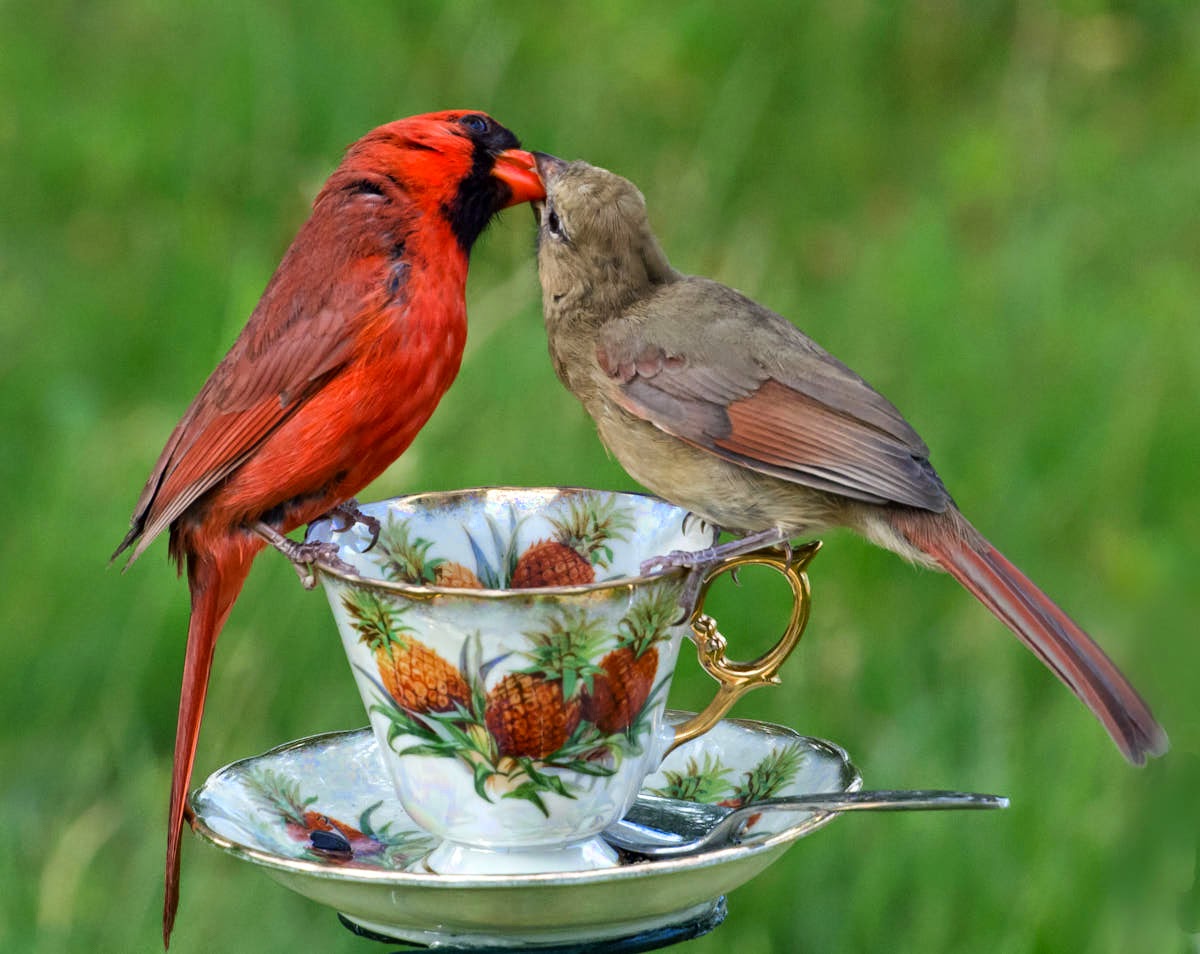
Besides their red plumage, cardinals are also known for their large repertoire of songs. Unlike most songbirds, cardinals sing all year long. In addition to their famous "cheer, cheer, cheer" song, they often throw in a "wheet, wheet, wheet", or "chew, chew, chew", or a "cheedle, cheedle, cheedle". During courtship, a male is often seen feeding a female. He will continue to feed her while she sits on the nest. While most songbird singing is restricted to the males, female cardinals are known to sing to the male while sitting on the nest.

Diet
The northern cardinal eats a wide variety of seeds (including those from pine trees, smartweed, bindweed, foxtail, dock, thistle, chickweed, button weed, sorrel, and a great variety of grasses), fruits (including grapes, dogwood fruit, blackberries, cherries, and raspberries), and even the buds of some trees (including elm and chokecherry). They also eat insects and, in fact, rely almost exclusively on insects as food for their rapidly growing young. Cardinals are also very common visitors to backyard bird feeders and avidly consume large quantities of sunflower seeds. The northern cardinal is not migratory and will remain even in the most northern parts of its geographic range throughout the winter especially if it is sustained by human-maintained birdfeeders..


Reproduction

Males sometimes bring nest material to the female, who does most of the building. She crushes twigs with her beak until they’re pliable, then turns in the nest to bend the twigs around her body and push them into a cup shape with her feet.
   Cardinals usually raise two broods of young a year. They mate in March and again from May to July. The female usually lays four eggs. The eggs take about 12 days to hatch. Cardinals usually build cup-shaped nests in small trees, bushes, shrubs and thick vines that are no more than three to eight feet off the ground. Their nests are made of twigs and bark and are lined with grass, moss and other soft materials. Young cardinals leave the nest after 11 days and they can fly within 20 days.
   The male tends to the newly fledged young while the female begins incubating the next clutch of eggs. Producing this large number of young each season helps the cardinal species survive.
   One of the dangers cardinals face is becoming a parent to a Brown-headed Cowbird. Cowbirds lay their eggs in other bird's nests and
destroy the host's young in the process. The adopted parents then raise the cowbird chick as if it was their own.

Did you know?

Male cardinals are feisty! If they see their reflection, they will fight for hours to scare off the “other bird” that they see as a threat..
While cardinals do not molt into duller plumage in the Fall, some cardinals experience drastic molts that often leave them ‘bald’. For some reason, many cardinals lose all of their head feathers at the same time, leaving a bald bird behind. While in some cases, the loss of feathers are a result of lice or poor nutrition, most of the time, new feathers will grow in on their own to produce the wonderful plumage cardinals are known best for.
 Unlike many other songbirds in North America, both the male and female cardinals can sing. Usually, only a male songbird is capable of singing.
On a related note, when a female cardinal sings from the nest, it usually means she’s telling the male she needs more food.


Photos by others.

photo from Birds Guide All about Birds.

Jane Walker's Cards

ourbeautifulworldanduniverse.com


Credits

The Cornell Lab of Ornithology, Maryland's Wild Acres,Avibase

Thursday, July 10, 2014

Saddle-billed Stork


Saddle-billed  Stork - Żabiru afrykański


Africa, Botswana, 2012

Description


It is spectacularly plumaged, identical in male and female when perched but the female shows much more white in the primaries in flight. The head, neck, back, wings, and tail are iridescent black, with the rest of the body and the primary flight feathers being white. Juveniles are browner grey in plumage. The massive bill is red with a black band and a yellow frontal shield (the "saddle"). The legs and feet are black with pink hocks. On the chest is a bare red patch of skin, whose color darkens during breeding season.

This is a huge bird that regularly attains a height of 59 in, a length of 56 in and a 7.9–8.9 ft. wingspan. The male is larger and heavier than the female, with a range of 11–17 lb. It is probably the tallest of the
storks (though not the heaviest), due in no small part to it extremely long legs (tarsus length is up to 14.4 in)). The long bill measures from 10.7 to 14.2 in. The sexes can be readily distinguished by the golden yellow irises of the female and the brown irises and dangling yellow wattles of the male. When in flight, they extend their necks to full length, drooping their heads slightly under the weight of the bill. This gives them a rather unique appearance.


Habitat

It inhabits extensive fresh, brackish or alkaline wetlands in open, semi-arid areas and savanna, with relatively high abundances of fish and with large trees nearby for nesting and roosting (although it avoids deeply forested areas). Suitable habitats include shallow freshwater marshes, wet grasslands, the margins of large or small rivers, lake shores, pans and flood-plains.

Voice

They are silent except for bill-clattering at the nest.

Diet
The saddle-billed stork, like most of its relatives, feeds mainly on fish, frogs and crabs, but also on small birds and reptiles. They move in a deliberate and stately manner as they hunt, in a similar way to the larger herons.

Reproduction

These storks are most frequently found in pairs and are very territorial. They communicate by clattering their bill at the nest occasionally, but are otherwise rather quiet. The Saddle-billed Stork pairs for life, and will reuse their nest. The male and the female birds work together to construct their nest. They will choose the top boughs of a tree that is situated near to wetlands as the safest spot to hatch and rear their young. This is no mean feat as the nest has to be rather large, since it needs to accommodate the whole bird in a sitting position. The female stork lays between one and five eggs. The chicks are fed by both parents, and reach fledgling age at between 58 and 100 days old. Both members of the pair incubate the eggs for between 32 and 35 days. The longest lifespan of a Saddle-billed Stork in captivity is just over 30 years.
Photos by others.

commons.wikimedia

Dean J. Tatooles

JOS WANTEN


Credits

SA-Venues.com , Wikipedia, 

Friday, July 4, 2014

Cocoi Heron


                                                         Cocoi Heron - Czapla czarnobrzucha


Brazil, Pantanal, 2013

Description
Best known of the typical herons are the very large, long-legged and long-necked, plain-hued, crested members of the genus Ardea The species of the Ardeidae (heron) family are mainly tropical birds, but they have spread out all over the world and occupy all but extremely high latitudes and elevation. Most members of this almost worldwide group breed colonially in trees, building large stick nests. Northern species such as Great Blue, Grey and Purple Herons may migrate south in winter, although the first two do so only from areas where the waters freeze. These are powerful birds with large spear-like bills, long necks and long legs, which hunt by waiting motionless or stalking their prey in shallow water before seizing it with a sudden lunge. They have a slow steady flight, with the neck retracted as is characteristic of herons and bitterns; this distinguishes them from storks, cranes, and spoonbills, which extend their necks.


Habitat

The Cocoi Heron frequents a great variety of wetlands, both fresh and salt water. It can be seen in shallow swamps, open wetlands, mangroves, rivers, lake shores, coastal mudflats and estuaries.
It usually avoids the inland dense forest and the arid coasts, preferring the marshy areas with forested fringes.
This species usually occurs in lowlands, but it can be seen up to 2550 meters of elevation and more in Colombia and Bolivia.

Generally sedentary, though birds in extreme South of range probably migrate North during winter. Also some post-breeding dispersal. Occasionally reaches Strait of Magellan and Lake Kami in far South. Non-breeding visitor to Trinidad mainly Jan-Jun. Accidental to Falklands and Gough Island. Usually sedentary bird in Suriname, some post breeding dispersal.
Voice

The Cocoi Heron utters guttural calls, either at roost and at colonies, or in flight “gawk uk, guk uk, guk uck uck” in more or less long series.

Diet
The Cocoi Heron feeds on fish, amphibians and aquatic insects, but according to the range, it may take other food items such as dead or dying animals, and mainly large fish of about 20 cm long.


Reproduction

The breeding season varies with the range, in July in Surinam, and between August and November in Brazil and Argentina.
The Cocoi Heron is a colonial breeder and nests in large colonies, sometimes with other species.
The nest is a deep cup made with sticks, twigs and reeds, and lined with grass. It is placed in trees or bushes.

The female lays 3-4 pale blue eggs with white markings. The incubation lasts 24-26 days, by both parents. The young birds remain at nest during a maximum of 12-13 weeks, but they wander off from the nest at about 6-7 weeks of age.


Photos by others.


Photo by Steve Mandel

verdeverdugo.blogspot.com


furandfeathers5000.blogspot


Credits

Oiseaux-birds.com, Planetofbirds, Avibase

Hyacinth Macaw


                                                        Hyacinth Macaw - Modroara hiacyntowa


Brazil, Pantanal, 2013

Description
The Hyacinth Macaw (Anodorhynchus hyacinthinus), or Hyacinthine Macaw, is a parrot native to central and eastern South America. With a length (from the top of its head to the tip of its long pointed tail) of about 100 cm (3.3 ft.) it is longer than any other species of parrot. It is the largest macaw and the largest flying parrot species, though the flightless Kakapo of New Zealand can outweigh it at up to 3.5 kg. While generally easily recognized, it can be confused with the far rarer and smaller Lear's Macaw. Habitat loss and trapping wild birds for the pet trade has taken a heavy toll on their population in the wild. The tail is long and pointed. Its feathers are entirely blue, lighter above. However, sometimes, the neck feathers can be slightly grey.


Habitat
The Hyacinth Macaw survives today in three main populations in South America: In the Pantanal region of Brazil, and adjacent eastern Bolivia and northeastern Paraguay, in the Cerrado region of the eastern interior of Brazil, and in the relatively open areas associated with the Tocantins River,Xingu River, Tapajos River, and the Marajo island in the eastern Amazon Basin of Brazil. It is possible that smaller, fragmented populations occur in other areas. It prefers palm swamps, woodlands, and other semi-open wooded habitats. It usually avoids dense humid forest, and in regions dominated by such habitats, it is generally restricted to the edge or relatively open sections (e.g. along major rivers). In different areas of their range these parrots are found in savannah grasslands, in dry thorn forest known as caatinga, and in palm stands, particularly the Moriche Palm.

Voice


Diet
The majority of the hyacinth macaw diet is nuts from native palms, such as acuri and bocaiuva palms. They have a very strong beak for eating the kernels of hard nuts and seeds. Their strong beaks are even able to crack coconuts, the large brazil nut pods and macadamia nuts. The birds also boast large, powerful beaks that easily crack nuts and seeds, while their dry, scaly tongues have a bone inside them that makes them an effective tool for tapping into fruits. Acuri nut is so hard that the parrots cannot feed on it until it has passed through the digestive system of cattle. In addition, they eat fruits and other vegetable matter. The Hyacinth Macaw in as a whole generally eats fruits, nuts, nectar, and various kinds of seeds. Also they will travel for the ripest of foods over a vast location. In the Pantanal, Hyacinth Macaws feed almost exclusively on the nuts of Acrocomia aculeata and Attalea phalerata palm trees.
Reproduction

Nesting takes place between July and December, nests are constructed in tree cavities or cliff faces depending on the habitat. In the Pantanal region, 90% of nests are constructed in the manduvi tree. The Hyacinth depends on its predator, the toucan, for its livelihood. The toucan contributes largely to seed dispersal of the Manduvi tree that the Macaw needs for reproduction. However, the toucan is responsible for dispersing 83% of the seeds of Sterculia apetala, but also consumes 53% of eggs predated. Hollows of sufficient size are only found in trees of around 60 years of age or older, and competition is fierce. Existing holes are enlarged and then partially filled with wood chips. The clutch size is one or two eggs, although usually only one fledgling survives as the second egg hatches several days after the first, and the smaller fledgling cannot compete with the first born for food. A possible explanation for this behavior is what is called the insurance hypothesis. The macaw will lay more eggs than can be normally fledged to compensate for earlier eggs that failed to hatch or first born chicks that did not survive. The incubation period lasts about a month, and the male will tend to his mate whilst she incubates the eggs. The chicks leave the nest, or fledge, at around 110 days of age, and remain dependent on their parents until six months of age. They are mature and begin breeding at seven years of age.

Did you know?

Limited tool use has been observed in both wild and captive hyacinth macaws. There exist reported sightings of tool use in wild parrots going as far back as 1863. Examples of tool use that have been observed usually involve a chewed leaf or pieces of wood. Macaws will often incorporate these items when feeding on harder nuts. The use of these items allows the nuts the macaws eat to remain in position (prevent slipping) while they gnaw into it. It is not known whether this is learned social behavior or an innate trait but observation on captive macaws shows that hand-raised macaws exhibit this behavior as well. Comparisons show that older macaws were able to open seeds more efficiently.
 The Hyacinth Macaw is an endangered species due to the cage bird trade and habitat loss. In the 1980s, it is estimated that at least 10,000 birds were taken from the wild and at least 50% were destined for the Brazilian market. Throughout the macaw’s range, habitat is being lost or altered due to the introduction of cattle ranching and mechanized agriculture, and the development of hydroelectric schemes. Annual grass fires set by farmers can destroy nest trees, and regions previously inhabited by this macaw are now unsuitable also due to agriculture and plantations. Locally, it has been hunted for food, and the
Kayapo Indians of Gorotire in south-central Brazil use its feathers to make headdresses and other ornaments.

Photos by others.


Credits

 Wikipedia, Avibase

Black-collared Hawk


Black-collared Hawk - Myszołów białogłowy


Brazil, Pantanal, 2013

Description
Medium-sized hawks with long broad wings and short, broad tail. The moderately hooked bill is rather long, as are the legs. The bottom of the feet are covered with prickly spicules used for catching fish. The feathers of the crown and nape are pointed, forming a slight crest. The plumage is extensively rufous, and there is only a moderate difference between the immature and the adult. The adult Black-collared Hawk has a more or less white head, tinged with buff, and with black shaft streaks on the crown. The body, above and below, and the mantle are bright cinnamon-rufous, paler on the chest. There is a black crescent on the upper breast. The back has scattered black shaft stripes; the flight and tail feathers are black with the base of the tail barred with rufous. The eyes are bright reddish brown, the cere and bill black, and the legs bluish white. Immature are similar, but blotched with black, including on the crown, and the rufous barring on the tail is more extensive. The pale area on the chest is also more clearly marked. The upper surface of the wings is barred, and the eyes are brown.


Habitat

Prefers rain forest, flooded forest and flooded land including rice fields. Found up to 800 meters. Found near water, in open or semi-open country, it is often quite common. In parts of their range where dykes or roads cross wetland and paddy fields they can often be seen on every third or fourth telegraph pole. When watching for food, they may perch in trees or bushes along or over water.

Voice


Diet
The Black-collared Hawk lives on a diet mainly composed of fish. Also water bugs and occasionally lizards, snails and rodents. Their feet are spiny for catching fish, and it sometimes swoops down with scarcely a wing beat and catch one without wetting the plumage, in the manner of the African Fish Eagle. At other times it may plunge awkwardly into shallow water from a low perch. On these occasions it may be seen sitting for some time drying its plumage.
Reproduction

The nest is usually placed in a large tree, frequently near water, but sometimes in shade trees in coffee plantations or suburban areas. The nest is lined with green leaves. The female lays three to five eggs, dull white, spotted with pale yellow-brown or red-brown and a few darker freckles. There is no further information on its reproduction.
Photos by others.


Credits

Planetofbirds.com, Avibase