Fan Of Birds

Fan Of Birds
Showing posts with label birds life. Show all posts

Tuesday, July 29, 2014

Cormorant - Neotropic


                                                     Cormorant  Neotropic - Kormoran oliwkowy


                                                  Brazil, Pantanal, 2013

Description

Most commonly found in the American tropics and subtropics, the Neotropic Cormorant (Phalacrocorax brasilianus) is a fairly large bird that generally nests around well-watered areas or lakes and rivers. Besides being found on the mainland of North America as far up as Rio Grand and the Californian coast through to Mexico, Central America and the southern parts of South America, it can also be found on smaller landmasses such as the Bahamas, Cuba and Trinidad. Most of these birds are permanent residents, though some do wander north in the warmer months. Because the bird is so widespread, some ornithologists prefer to treat those found north as one species and those found in the south as another species.
Non-migratory species, but evidences point out that some birds have a wide dispersion mainly along the river courses, up to 1,400 km from the born site.


Habitat

Inland and coastal wetlands, including fresh-water marshes, lakes, lagoons and rivers; blackish lagoons, marine coasts, offshore islands, estuaries, tidal creeks and saltmarshes, fishing ponds and rice fields.
Voice

These cormorants have a distinct sound they make which sounds very much like a pig’s grunt.

Diet

Mostly eating fish, the Neotropic Cormorant also will eat small amphibians and sometimes even tadpoles, shrimp and water insects. This cormorant forages for food by diving underwater, propelling itself by its feet. Its dives are brief, between 5 and 15 seconds but often hunt in groups, beating the water with their wings to scare up the fish. But they also eat tadpoles, frogs, and aquatic insects.


Reproduction

They often nest in trees or shrubs creating a structure of sticks sometimes held together by their own feces and sometimes lined with grass, feathers, sea-weed or shells. These birds usually live and nest in colonies but are monogamous. Neotropic Cormorants lay from one to five light- blue eggs with an incubation period of usually no more than 30 days. Most often only one clutch is laid per year even though the chicks become independent around 10 to 12 weeks of age.

Did you know?

In the Shetland Islands they know that the Cormorant is very easily domesticated, and when treated with kindness will become exceedingly docile, exhibiting a very high degree of intelligence, and an amount of affection scarcely to be expected from a bird which in its wild state is remarkable for its extreme shyness of man.

In Norwegian myths and folklore, three cormorants flying together are said to be carrying messages and warnings from the dead. In northern Norway, cormorants are considered to be good luck when they gather in a village. Norwegian myth also states that people who die at sea can visit their former homes in the form of a cormorant.

In Greek folklore fables the cormorant was once a wool-merchant. He entered into a partnership with the bramble and the bat, and they freighted a large ship with wool. She was wrecked and the firm became bankrupt. Since that disaster the bat skulks about until midnight to avoid his creditors, the cormorant is forever diving into the deep to discover its foundered vessel, while the bramble seizes hold of every passing sheep to make up the firm’s loss by stealing the wool.

Near the shores of the Zambesi river, in the shallow lake through which the Shire flows after leaving the Nyassa, the natives drive piles in the bottom, at a distance from shore, and rising a foot above the surface. An elastic piece of wood, with a noose attached, is placed on the main pile, and serves to trap the Cormorants and Darters, which come to rest on them.

Photos by others.


photo by Rathika Ramasamy

Wikimedia


Carolinabirds


Credits

Birds.com, Planetofbirds.com,Wikipedia,Avibase

Monday, July 28, 2014

Northern Cardinal


 Northern Cardinal - Kardynał szkarłatny


Cresskill, New Jersey, 2014

Description
Cardinals belong to a group of birds called "grosbeaks", meaning that they have a thick bill especially adapted for cracking open and eating seeds.
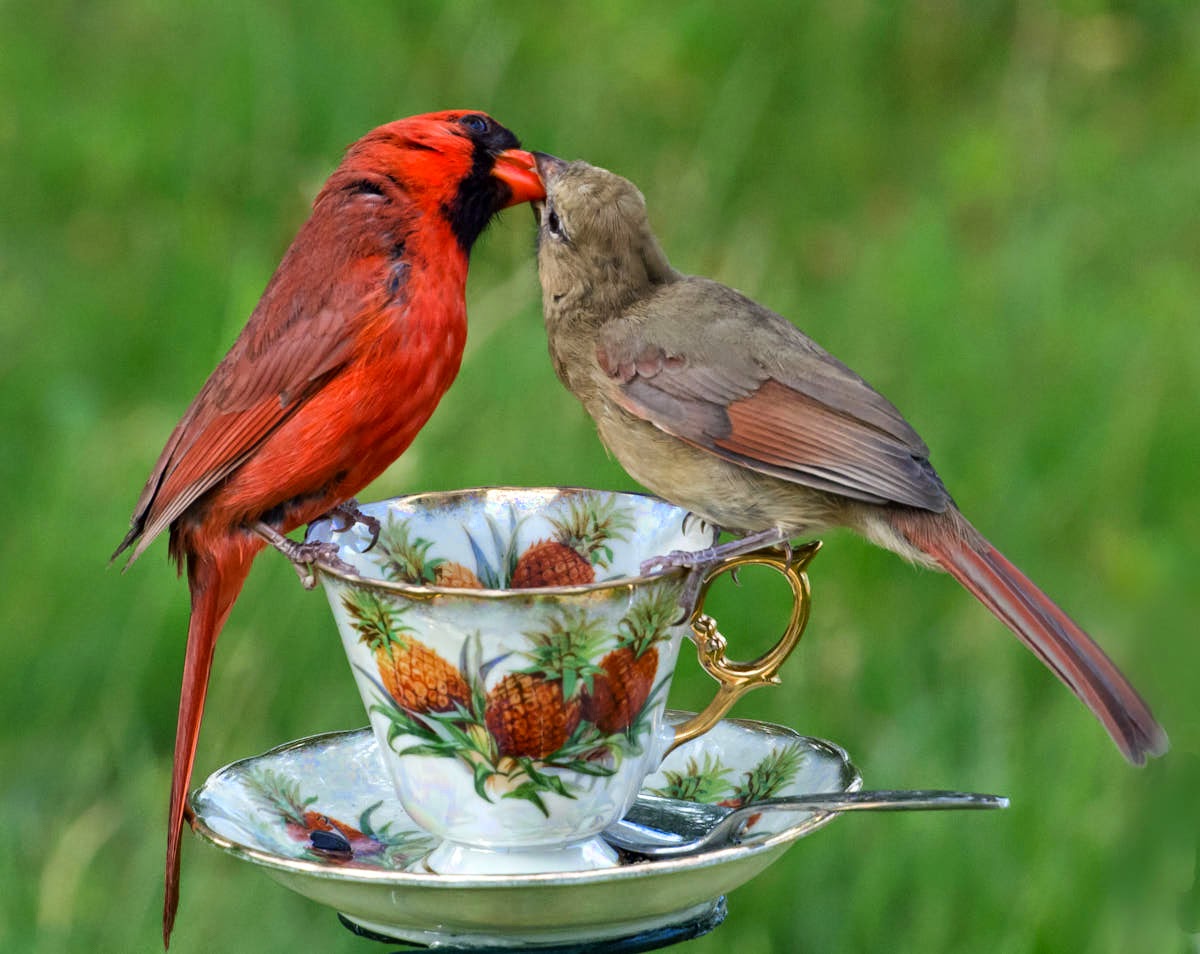
Male cardinals, or redbirds as they are sometimes called, can be distinguished from other birds by their bright red color, a black patch around the bill and a red crest on the head. Females are olive-brown with red wings and a red crest.
Cardinals are non-migratory birds. Most cardinals live within a mile of where they were born. Cardinals are song birds and the male uses its call to attract a mate.


Habitat

Look for Northern Cardinals in dense shrubby areas such as forest edges, overgrown fields, hedgerows, backyards, marshy thickets, mesquite, regrown forest, and ornamental landscaping. Cardinals nest in dense foliage and look for conspicuous, fairly high perches for singing. Growth of towns and suburbs across eastern North America has helped the cardinal expand its range northward.

Voice

Besides their red plumage, cardinals are also known for their large repertoire of songs. Unlike most songbirds, cardinals sing all year long. In addition to their famous "cheer, cheer, cheer" song, they often throw in a "wheet, wheet, wheet", or "chew, chew, chew", or a "cheedle, cheedle, cheedle". During courtship, a male is often seen feeding a female. He will continue to feed her while she sits on the nest. While most songbird singing is restricted to the males, female cardinals are known to sing to the male while sitting on the nest.

Diet
The northern cardinal eats a wide variety of seeds (including those from pine trees, smartweed, bindweed, foxtail, dock, thistle, chickweed, button weed, sorrel, and a great variety of grasses), fruits (including grapes, dogwood fruit, blackberries, cherries, and raspberries), and even the buds of some trees (including elm and chokecherry). They also eat insects and, in fact, rely almost exclusively on insects as food for their rapidly growing young. Cardinals are also very common visitors to backyard bird feeders and avidly consume large quantities of sunflower seeds. The northern cardinal is not migratory and will remain even in the most northern parts of its geographic range throughout the winter especially if it is sustained by human-maintained birdfeeders..


Reproduction

Males sometimes bring nest material to the female, who does most of the building. She crushes twigs with her beak until they’re pliable, then turns in the nest to bend the twigs around her body and push them into a cup shape with her feet.
   Cardinals usually raise two broods of young a year. They mate in March and again from May to July. The female usually lays four eggs. The eggs take about 12 days to hatch. Cardinals usually build cup-shaped nests in small trees, bushes, shrubs and thick vines that are no more than three to eight feet off the ground. Their nests are made of twigs and bark and are lined with grass, moss and other soft materials. Young cardinals leave the nest after 11 days and they can fly within 20 days.
   The male tends to the newly fledged young while the female begins incubating the next clutch of eggs. Producing this large number of young each season helps the cardinal species survive.
   One of the dangers cardinals face is becoming a parent to a Brown-headed Cowbird. Cowbirds lay their eggs in other bird's nests and
destroy the host's young in the process. The adopted parents then raise the cowbird chick as if it was their own.

Did you know?

Male cardinals are feisty! If they see their reflection, they will fight for hours to scare off the “other bird” that they see as a threat..
While cardinals do not molt into duller plumage in the Fall, some cardinals experience drastic molts that often leave them ‘bald’. For some reason, many cardinals lose all of their head feathers at the same time, leaving a bald bird behind. While in some cases, the loss of feathers are a result of lice or poor nutrition, most of the time, new feathers will grow in on their own to produce the wonderful plumage cardinals are known best for.
 Unlike many other songbirds in North America, both the male and female cardinals can sing. Usually, only a male songbird is capable of singing.
On a related note, when a female cardinal sings from the nest, it usually means she’s telling the male she needs more food.


Photos by others.

photo from Birds Guide All about Birds.

Jane Walker's Cards

ourbeautifulworldanduniverse.com


Credits

The Cornell Lab of Ornithology, Maryland's Wild Acres,Avibase

Sunday, April 13, 2014

Bare-faced Ibis

Bare-faced Ibis - Ibis Ostrosterny


Brazil, Pantanal, 2013

Description

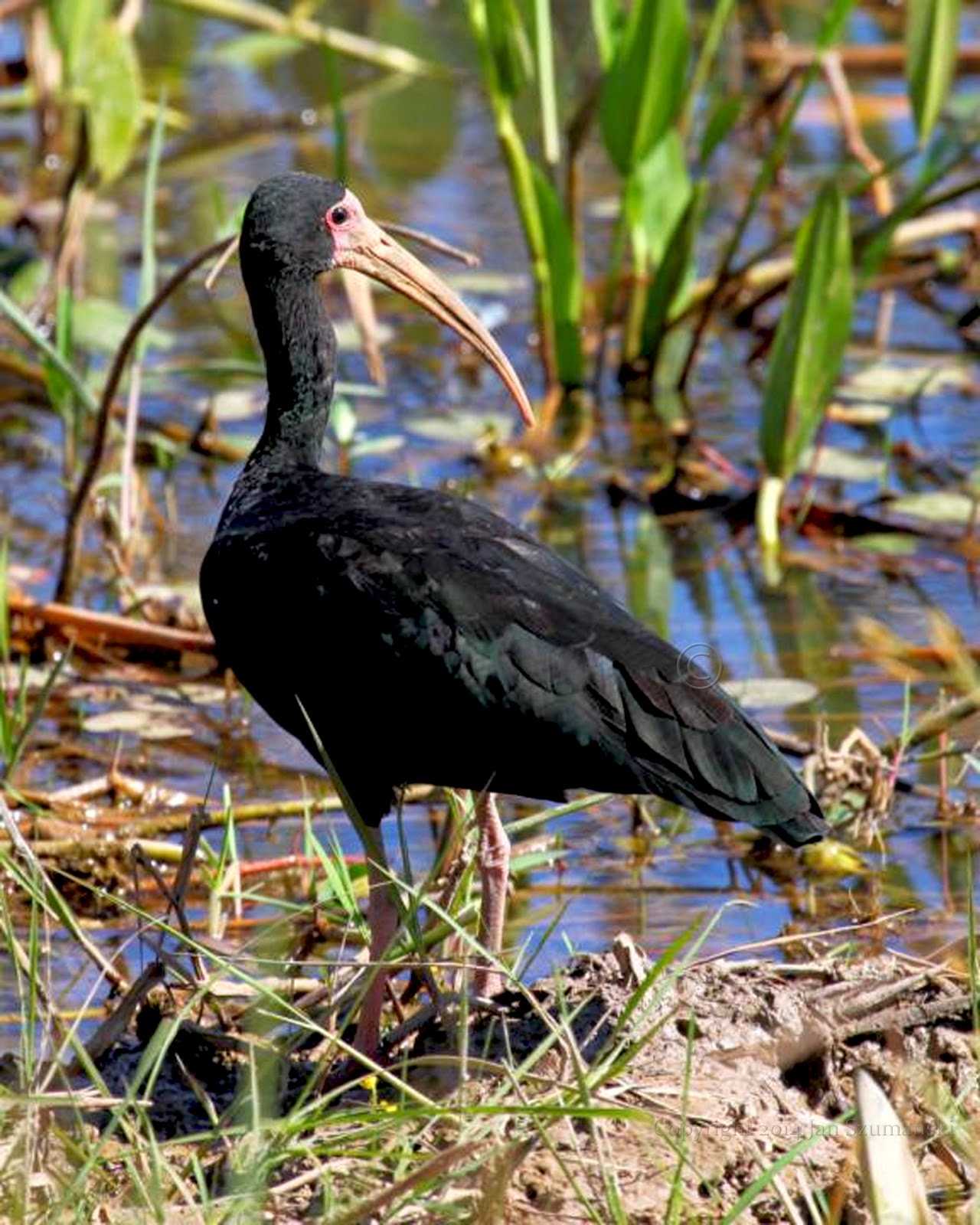
The Bare-faced Ibis is a small, dull ibis of open marshes throughout much of South America. It is smaller, and shorter-legged, than any other Neotropical ibis. This Ibis is darkish red overall. It has bare red skin on the face and a long, pink to yellow bill. In flight its pink legs barely extend beyond its tail, a feature which distinguishes it from flying White-faced Ibis whose longer legs extend noticeably beyond the tail. Flight strong, with steady fast wing beats; glides less than White-faced. Often seen flying overhead, moving between its feeding and roosting sites.


Habitat

It occurs from northern Colombia east through the Venezuelan llanos and from eastern Brazil west to Bolivia and south to central Argentina. It is found in marshes and open areas around ponds and lakes.
Sound

Sound of Bare-faced Ibis


Diet

Bare-faced ibises are often found foraging in moist soil as well as along the edge of standing water. They rarely step in to the water. The diet consists of worms, small invertebrates and insects. Follows cattle to forage the disturbed prey. Usually found solitary or in small groups.

Reproduction

Breeds solitary or in loose colonies, usually in smaller groups or in mixed larger groups. Builds nest low above ground, out of sticks and twigs. Clutch size is 2-5 eggs which are incubated for about 3 weeks. Young fledge after about 4 weeks more. This species is highly sensitive to predation with colonies loosing up to 80% of the chicks in Venezuela.

Photos by others