Fan Of Birds

Fan Of Birds
Showing posts with label Africa. Show all posts

Friday, October 3, 2014

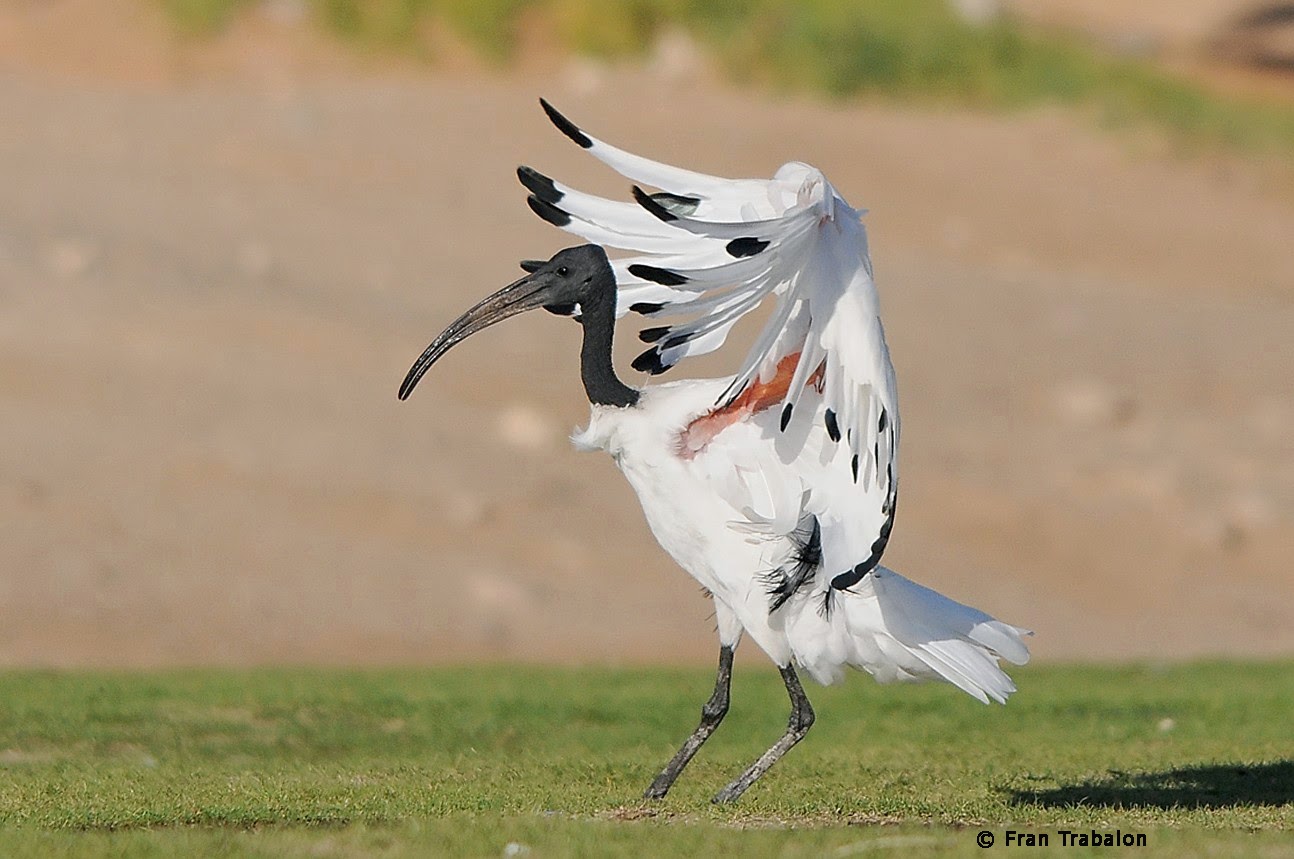
Sacred Ibis

Sacred Ibis - Ibis czczony


 Tanzania, 2014
 
Description
The distinctive African sacred ibis is characterized by its large size, primarily white plumage and conspicuous black head and neck, which lack feathers. One of the most prominent features of this bird is its long, black, down curved bill, which has a neck sac positioned underneath its lower surface and is used for probing into soft mud and sand in pursuit of prey. The male and female African sacred ibis are similar in appearance, although males are larger than females and frequently have a longer bill. The sacred ibis breeds in north from South Africa to Sudan and Niger. But is absent in may regions within Cameroon, Congo, Gabon and the Central African Republic. This species was formerly found in Egypt, although it is now thought to be regionally extinct there. Nomadic or migratory. Movements of several hundred kilometers to breed during rains; birds N of equator move northwards, those S of equator southwards, both returning at end of rains or early in dry season. 


Habitat

The African sacred ibis is found in a wide range of habitats, including freshwater wetlands, salt pans, dams, mangroves, rivers in open forested areas, and cultivated fields. Human environments are also inhabited by this species and it is frequently found around refuse dumps, abattoirs and farmyards. In Zambia, it has been recorded up to elevations of 1,800 meters.
Voice

    The vocalizations of the African sacred ibis are highly variable, with harsh croaking noises being made during flight and squeaking ‘whoot-whoot-whoot-whooeeoh’ or ‘pyuk-pyuk-peuk-peuk-pek-peuk’ calls made while individuals are on their breeding grounds. Vocalizations are also used by females to attract males and during copulation.

Diet
    An opportunistic, mainly carnivorous feeder, the African sacred ibis takes a range of insects, worms, bird and reptile eggs, crustaceans, frogs, lizards, small mammals and carrion. It uses its long bill to probe into mud and soil to capture prey, as well as chasing moving prey with its wings half open. Certain populations forage around rubbish dumps and slurry pits, with some becoming reliant on these areas as a food source.
Reproduction
      The breeding season of the African sacred ibis differs geographically, but usually begins during or shortly after the rainy season. Large, mixed-species colonies are formed, which include between 50 and 2,000 breeding pairs. The male collects the nest materials and the female assembles the structure. The nest is a large platform of sticks and branches, which is lined with leaves and grass and placed in a tree, bush or on the ground. When nest materials are in short supply, males may attempt to steal objects from other individuals within the colony. Once the nest is complete, the female African sacred ibis then lays an average clutch of two or three eggs, which have a rough surface and are dull white with a blue or green tinge and red-brown spots. The male and female take turns to incubate the eggs, usually changing over every 24 hours. The incubation period lasts around 28 days, after which the nestlings are fed and cared for by both adults, with one finding food while the other remains at the nest. The nestlings eventually fledge the nest when they are between 35 and 40 days old. A fledgling will leave its colony when it is between 44 and 48 days old. The pair bond between the male and female African sacred ibis lasts for one breeding season.


Photos by others
 
 
www.templeilluminatus.com
 
ibc.lynxeds.com

 
galleryhip.com


Credits

Thursday, July 10, 2014

Saddle-billed Stork


Saddle-billed  Stork - Żabiru afrykański


Africa, Botswana, 2012

Description


It is spectacularly plumaged, identical in male and female when perched but the female shows much more white in the primaries in flight. The head, neck, back, wings, and tail are iridescent black, with the rest of the body and the primary flight feathers being white. Juveniles are browner grey in plumage. The massive bill is red with a black band and a yellow frontal shield (the "saddle"). The legs and feet are black with pink hocks. On the chest is a bare red patch of skin, whose color darkens during breeding season.

This is a huge bird that regularly attains a height of 59 in, a length of 56 in and a 7.9–8.9 ft. wingspan. The male is larger and heavier than the female, with a range of 11–17 lb. It is probably the tallest of the
storks (though not the heaviest), due in no small part to it extremely long legs (tarsus length is up to 14.4 in)). The long bill measures from 10.7 to 14.2 in. The sexes can be readily distinguished by the golden yellow irises of the female and the brown irises and dangling yellow wattles of the male. When in flight, they extend their necks to full length, drooping their heads slightly under the weight of the bill. This gives them a rather unique appearance.


Habitat

It inhabits extensive fresh, brackish or alkaline wetlands in open, semi-arid areas and savanna, with relatively high abundances of fish and with large trees nearby for nesting and roosting (although it avoids deeply forested areas). Suitable habitats include shallow freshwater marshes, wet grasslands, the margins of large or small rivers, lake shores, pans and flood-plains.

Voice

They are silent except for bill-clattering at the nest.

Diet
The saddle-billed stork, like most of its relatives, feeds mainly on fish, frogs and crabs, but also on small birds and reptiles. They move in a deliberate and stately manner as they hunt, in a similar way to the larger herons.

Reproduction

These storks are most frequently found in pairs and are very territorial. They communicate by clattering their bill at the nest occasionally, but are otherwise rather quiet. The Saddle-billed Stork pairs for life, and will reuse their nest. The male and the female birds work together to construct their nest. They will choose the top boughs of a tree that is situated near to wetlands as the safest spot to hatch and rear their young. This is no mean feat as the nest has to be rather large, since it needs to accommodate the whole bird in a sitting position. The female stork lays between one and five eggs. The chicks are fed by both parents, and reach fledgling age at between 58 and 100 days old. Both members of the pair incubate the eggs for between 32 and 35 days. The longest lifespan of a Saddle-billed Stork in captivity is just over 30 years.
Photos by others.

commons.wikimedia

Dean J. Tatooles

JOS WANTEN


Credits

SA-Venues.com , Wikipedia, 

Monday, April 14, 2014

Bearded Woodpecker

Bearded Woodpecker - Dzięcioł Sawannowy


Africa, Botswana, Okavango Delta, 2012


Description
The four savanna woodpecker species are superficially very alike in appearance and coloration and therefore misidentifications would have occurred, but probably somewhat less frequently in case of the Bearded Woodpecker which is noticeably larger and his similar bold facial markings in both the male and female. It also has distinctive drumming behavior which renders it conspicuous, and this may account for its comparatively high reporting rates. The sexes look very similar, except that the males have a small red patch on the back of their head.

Habitat

The Bearded woodpecker occurs from central Africa to southern Africa. It dislikes dense forest, preferring deciduous woodland and savanna. Any broad-leaved woodland in which there are tall trees, especially dead trees, is optimum habitat for this woodpecker.
Voice

Diet
It mainly forages in trees, tapping and probing branches in search of insects, licking them up with its barbed tongue. The following food items have been recorded in its diet: beetle larvae and pupae, Mopane emperor moth larvae, termite, spiders, lizards.
Reproduction

 Both sexes excavate the nest, which is usually a oval-shaped hole in the trunk of a tree, although it has been recorded nesting in fence posts. Here It lays 1-3 eggs, which are incubated by both sexes, for roughly 13 days. The chicks are cared for by both parents, leaving the nest at about 27 days old. The juveniles become fully independent roughly 1-2 months after fledging.

Did you know?

Because woodpeckers beat on trees with their powerful beaks to collect food, to construct their nests and to communicate with each other, they have evolved a number of anatomical features to prevent brain damage from repeated blows to their heads. These include small brain size, the orientation of the brain within the skull, which maximizes the contact area between the brain and the skull to keep it from rattling around inside the head. Additionally, in that millisecond before contact with wood, a thickened nictitating membrane closes, protecting the eyes from flying debris. Even their nostrils are protected; they are often slit-like and have special bristles that cover them.

Photos by others


Credits
Biodiversity Explorer

Sunday, April 13, 2014

Bateleur

Bateleur - Kuglarz


Africa, Botswana, Okavango Delta, 2012
Description
The Bateleur is a colorful species with a very short tail which, together with its white under wing coverts, makes it unmistakable in flight. The tail is so small the bird's legs protrude slightly beyond the tail during flight. The Bateleur is sexually dimorphic; both adults have black plumage, a chestnut mantle and tail, grey shoulders, tawny wing coverts, and red facial skin, bill and legs. The female additionally has tawny secondary wing feathers. Immature birds are brown with white dappling and have greenish facial skin. It takes them seven or eight years to reach full maturity. The bird spends a considerable amount of time on the wing, particularly in low-altitude glides. Incredibly, the Bateleur may spend as much as 80 percent of the day in flight, covering up to 500 kilometers, as it searches for food. Flying relatively low, this species scans the ground for signs of food and, when sighted, it descends in a tight spiral to investigate. When not in flight, the Bateleur can be seen perching on branches or standing on the ground with its wings outstretched, absorbing the heat from the sun.


Habitat

The Bateleur has an extensive range, encompassing most of Africa, from Mauritania in the west, across to Sudan in the east, and stretching north to Egypt and south to South Africa. The Bateleur mainly occupies savanna and open- and closed-canopy woodland, favoring broad-leaved woodland with long grass. Rarely in heavily wooded areas, mountainous areas and largely treeless habitats, but penetrates semi-desert shrub land with tall drainage-line woodland.
Voice
The Bateleur is generally silent, but on occasions it produces a variety of barks and screams.
Sounds of Bateleur

Diet
Bateleurs are hunters and scavengers; birds such as pigeons and sangrouse are preferred prey items, although it may attack small mammals. Their diet includes antelope, mice, birds, snakes, and carrion. Bateleur eagles spend 8-9 hours each day in the air looking for food.
Reproduction
The Bateleur breeds in December–March. It constructs a well-concealed nest in trees, laying a single egg. Mother incubates the egg while father collects food and sticks for the nest. Sometimes, however, the father incubates. After an incubation period of 52-59 days, the chick hatches. 110 days later, the hatchling fledges, but will continue to receive food from its parents for another 100 days. Only 2% of chicks make it to adulthood. Bateleurs pair for life, and will use the same nest for a number of years. Unpaired birds, presumably from a previous clutch, will sometimes help at the nest.

Did you know?
The Mbuti tribe believes that if a pregnant woman or her husband eat this bird, a baby with an extraordinary large head may be born to them.

The Temba tribe of the Congo consider the species as a cure. Its feathers and claws are used to cure benign epilepsy. For the medical treatment, feathers and claws of this bird are burnt and inhaled by the patient. Only old people can eat it. Also this bird makes noise while flying, like the wind. It sometimes carries away two-to three-year-old infants of goat, monkey, or hare.

The Zulu in South Africa believe that when creation began, when the tree of life produced living things, the first bird to fall off the tree of life, was the Ingonghulu, the Bateleur. To signal the birth of creation, the Ingonghulu extended her wings and beat them, GHU-GHU-GHU, and creation was announced. You were not allowed to kill this bird. It enjoyed the direct protection of the king of the Zulus. You were not allowed to harm this bird of victory. If it arrived in your area, it was immediately announced to the king that an Ingonghulu is nesting in such and such a place, and the king used to come there with his people and conduct a sacred ceremony there, to which no ordinary people were invited.


Photos by others


Credits
Wikipedia, Plenetofbirds.com, Arkive.com, Birds of Brazil (Wildlife Conservation Society)

Tuesday, April 8, 2014

African Jacana

African Jacana - Długoszpon Afrykański 


 Botswana, Okavango Delta, 2012
Description
African Jacanas (Actophilornis africanus) are waders in the family Jacanidae. The most conspicuous characteristic of these birds are their huge, grey feet and claws which enable them to walk on floating vegetation, especially lily pads. They are also very good swimmers and divers. They are about 30 cm long, but females are larger than males. They have chestnut upper parts with black wingtips, rear neck, and eye stripe. The under parts are also chestnut in the adults, only in juveniles they are white with a chestnut belly patch. The blue bill extends up as a coot-like head shield, and the legs and long toes are grey. The sexes look alike, but the female is a bit larger than the male.


Habitat

Jacanas are found worldwide within the tropical zone, and this species is found in sub-Saharan Africa. The African jacana is not migratory, but extremely nomadic, often in connection with changing water levels; in wet years, birds may show up on pans, from which the species has been absent for several years.

Voice

Diet
African Jacanas feed on insects and other invertebrates picked from the floating vegetation or the surface of the water. The African jacana mainly feeds on insects and worms, but also other arthropods, including spiders and crustaceans, and mollusks. Seeds are sometimes taken. Foraging similar to the Wattled Jacana, though the species may also catch flies and other flying insects.
Reproduction
African Jacanas breed throughout sub-Saharan Africa. It is sedentary apart from seasonal dispersion. It lays four black-marked brown eggs in a floating nest.

The jacana has evolved a highly unusually
polyandrous mating system, meaning that one female mates with multiple males and the male alone cares for the chicks. Such a system has evolved due to a combination of two factors: firstly, the lakes that the jacana lives on are so resource-rich that the relative energy expended by the female in producing each egg is effectively negligible. Secondly the jacana, as a bird, lays egg and eggs can be equally well incubated and cared for by a parent bird of either gender. This means that the rate-limiting factor of the jacana's breeding is the rate at which the males can raise and care for the chicks. Such a system of females forming harems of males is in direct contrast to the more usual system of leks seen in animals such as stags and grouse, where the males compete and display in order to gain harems of females.

The parent that forms part of the harem is almost always the one that ends up caring for the offspring; in this case, each male jacana incubates and rears a nest of chicks. The male African Jacana has therefore evolved some remarkable adaptations for parental care, such as the ability to pick up and carry chicks underneath its wings.


Did you know?
African Jacana have a polyandrous mating system, in which females can have multiple male partners. After mating and egg laying, the female leaves the nest site and may look for another mate while the male incubates and raises the young.


Photos by others


Credits
Wikipedia, Birds of Brazil (Wildlife Conservation Society)