Fan Of Birds

Fan Of Birds
Showing posts with label Cresskill. Show all posts

Monday, July 28, 2014

Northern Cardinal


 Northern Cardinal - Kardynał szkarłatny


Cresskill, New Jersey, 2014

Description
Cardinals belong to a group of birds called "grosbeaks", meaning that they have a thick bill especially adapted for cracking open and eating seeds.
Male cardinals, or redbirds as they are sometimes called, can be distinguished from other birds by their bright red color, a black patch around the bill and a red crest on the head. Females are olive-brown with red wings and a red crest.
Cardinals are non-migratory birds. Most cardinals live within a mile of where they were born. Cardinals are song birds and the male uses its call to attract a mate.


Habitat

Look for Northern Cardinals in dense shrubby areas such as forest edges, overgrown fields, hedgerows, backyards, marshy thickets, mesquite, regrown forest, and ornamental landscaping. Cardinals nest in dense foliage and look for conspicuous, fairly high perches for singing. Growth of towns and suburbs across eastern North America has helped the cardinal expand its range northward.

Voice

Besides their red plumage, cardinals are also known for their large repertoire of songs. Unlike most songbirds, cardinals sing all year long. In addition to their famous "cheer, cheer, cheer" song, they often throw in a "wheet, wheet, wheet", or "chew, chew, chew", or a "cheedle, cheedle, cheedle". During courtship, a male is often seen feeding a female. He will continue to feed her while she sits on the nest. While most songbird singing is restricted to the males, female cardinals are known to sing to the male while sitting on the nest.

Diet
The northern cardinal eats a wide variety of seeds (including those from pine trees, smartweed, bindweed, foxtail, dock, thistle, chickweed, button weed, sorrel, and a great variety of grasses), fruits (including grapes, dogwood fruit, blackberries, cherries, and raspberries), and even the buds of some trees (including elm and chokecherry). They also eat insects and, in fact, rely almost exclusively on insects as food for their rapidly growing young. Cardinals are also very common visitors to backyard bird feeders and avidly consume large quantities of sunflower seeds. The northern cardinal is not migratory and will remain even in the most northern parts of its geographic range throughout the winter especially if it is sustained by human-maintained birdfeeders..


Reproduction

Males sometimes bring nest material to the female, who does most of the building. She crushes twigs with her beak until they’re pliable, then turns in the nest to bend the twigs around her body and push them into a cup shape with her feet.
   Cardinals usually raise two broods of young a year. They mate in March and again from May to July. The female usually lays four eggs. The eggs take about 12 days to hatch. Cardinals usually build cup-shaped nests in small trees, bushes, shrubs and thick vines that are no more than three to eight feet off the ground. Their nests are made of twigs and bark and are lined with grass, moss and other soft materials. Young cardinals leave the nest after 11 days and they can fly within 20 days.
   The male tends to the newly fledged young while the female begins incubating the next clutch of eggs. Producing this large number of young each season helps the cardinal species survive.
   One of the dangers cardinals face is becoming a parent to a Brown-headed Cowbird. Cowbirds lay their eggs in other bird's nests and
destroy the host's young in the process. The adopted parents then raise the cowbird chick as if it was their own.

Did you know?

Male cardinals are feisty! If they see their reflection, they will fight for hours to scare off the “other bird” that they see as a threat..
While cardinals do not molt into duller plumage in the Fall, some cardinals experience drastic molts that often leave them ‘bald’. For some reason, many cardinals lose all of their head feathers at the same time, leaving a bald bird behind. While in some cases, the loss of feathers are a result of lice or poor nutrition, most of the time, new feathers will grow in on their own to produce the wonderful plumage cardinals are known best for.
 Unlike many other songbirds in North America, both the male and female cardinals can sing. Usually, only a male songbird is capable of singing.
On a related note, when a female cardinal sings from the nest, it usually means she’s telling the male she needs more food.


Photos by others.
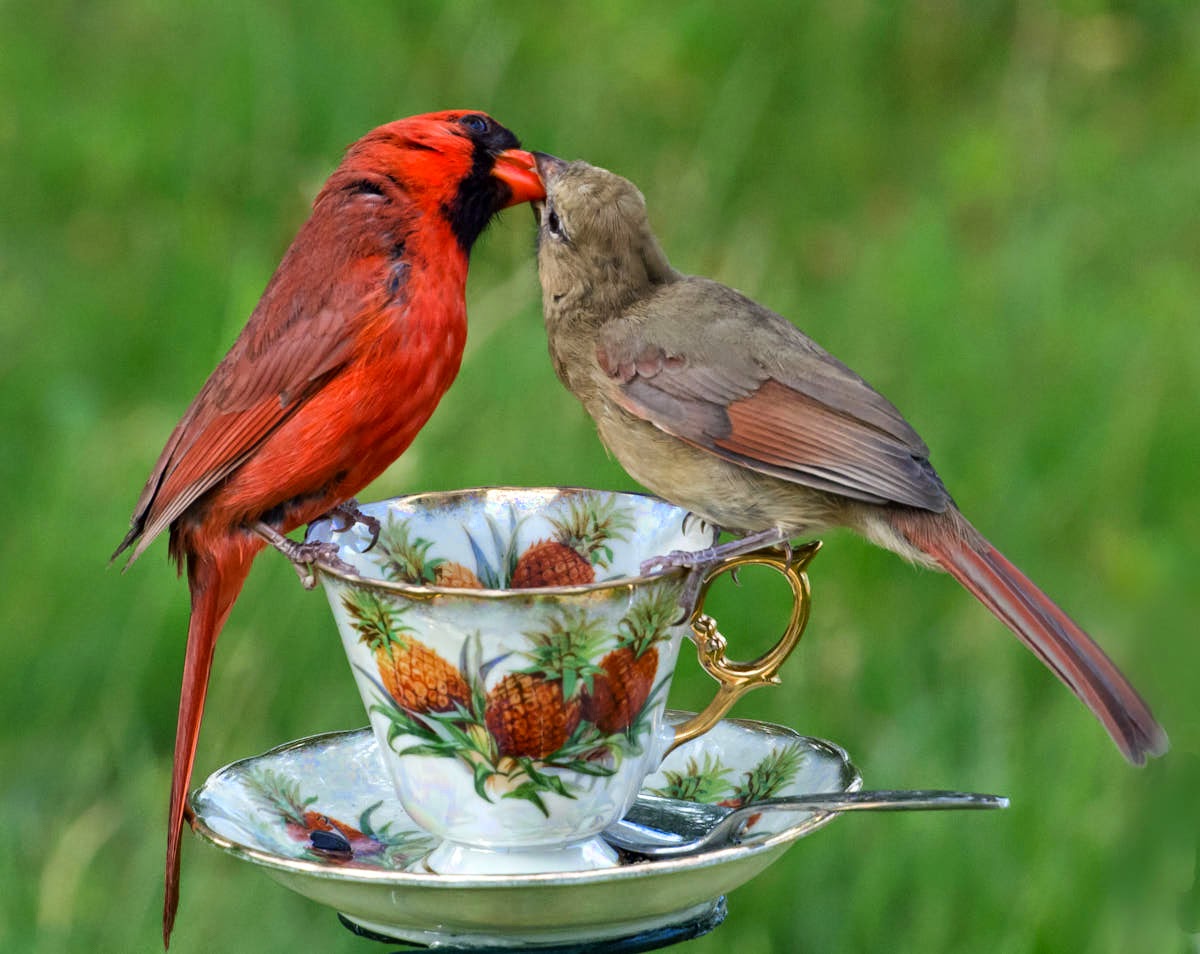
photo from Birds Guide All about Birds.

Jane Walker's Cards

ourbeautifulworldanduniverse.com


Credits

The Cornell Lab of Ornithology, Maryland's Wild Acres,Avibase

Monday, April 28, 2014

Barred Owl


Barred Owl - Puszczyk kreskowany


Cresskill, New Jersey, 2013

Description
The Barred Owl (Strix varia) is a large typical owl native to North America. Best known as the Hoot Owl for its distinctive call, it goes by many other names, including Eight Hooter, Rain Owl, Wood Owl, and Striped Owl. It has a pale face with dark rings around the eyes, a yellow beak and brown eyes. It is the only typical owl of the eastern United States which has brown eyes; all others have yellow eyes. The upper parts are mottled gray-brown. The underparts are light with markings; the chest is barred horizontally while the belly is streaked vertically. The legs and feet are covered in feathers up to the talons. The head is round and lacks ear tufts, a distinction from the slightly smaller Short-eared Owl, which favors more open, marginal habitats.


Habitat

A nocturnal bird. Hides in dense foliage during the day, usually high up. May also roost on a branch close to a broad tree-trunk, or in a natural tree hole. May be very aggressive when defending a nest. Breeding habitats are dense woods across Canada, the eastern United States, and south to Mexico; in recent years it has spread to the northwestern United States, having gradually spread farther south in the west.
Voice

A loud barking hoo, hoo, hoo-hoo; hoo, hoo; hoo, hooo-aw! and a variety of other barking calls and screams.

Diet
Mostly small mammals. Eats many mice and other small rodents, also squirrels (including flying squirrels), rabbits, opossums, shrews, other small mammals. Also eats various birds, frogs, salamanders, snakes, lizards, some insects. May take aquatic creatures such as crayfish, crabs, fish.
Behavior: Hunts by night or day, perhaps most at dawn and dusk. Seeks prey by watching from perch, also by flying low through forest; may hover before dropping to clutch prey in talons. Like many other owls, coughs up pellets of its prey.

Reproduction

The Barred Owl's nest is often in a tree cavity, often ones created by pileated woodpeckers; it may also take over an old nesting site made previously by a red-shouldered hawk, cooper's hawk, crow, or squirrel. It is a permanent resident, but may wander after the nesting season. If a nest site has proved suitable in the past they will often reuse it as the birds are non-migratory. In the United States, eggs are laid from early-January in southern Florida to mid-April in northern Maine, and consist of 2 to 4 eggs per clutch. Eggs are brooded by the female with hatching taking place approximately 4 weeks later. Young owls fledge four to five weeks after hatching. These owls have few predators, but young, unwary owls may be taken by cats. The most significant predator of Barred Owls is the Great Horned Owl.[ The Barred Owl has been known to live up to 10 years in the wild and 23 years in captivity.
Did you know?
The belly feathers of some Barred Owls are pink. This coloring may be the result of eating a lot of crayfish. A barred owl's right ear is higher than its left ear. Hearing from two different angles helps it pinpoint the location of prey.

Photos by others

http://commons.wikimedia.org/wiki/File:Barred-owl-chick-58.jpg


Credits
Wikipedia, The Owl Pages

American Robin


American Robin - Drozd wędrowny


Cresskill, New Jersey, 2013


Description
The American Robin is the largest, most abundant, and most widespread North American thrush. The presence of this rather tame songster in the backyard setting, together with its loud and musical voice, makes it one of the most easily recognizable birds in North America. The head varies from jet black to gray, with white eye arcs and white supercilia. The throat is white with black streaks, and the belly and undertail feather are white. The Robin has a brown back and a reddish-orange breast, varying from a rich red maroon to peachy orange. The bill is mainly yellow with a variably dark tip, the dusky area becoming more extensive in winter, and the legs and feet are brown. The American Robin is active mostly during the day, and on its winter grounds it assembles in large flocks at night to roost in trees in secluded swamps or dense vegetation.

Habitat

This bird breeds throughout most of North America, from Alaska and Canada southward to northern Florida and Mexico. While Robins occasionally overwinter in the northern part of the United States and southern Canada, most migrate to winter south of Canada from Florida and the Gulf Coast to central Mexico, as well as along the Pacific Coast. Most depart south by the end of August and begin to return north in February and March. The American Robin's breeding habitat is woodland and more open farmland and urban areas. It becomes less common as a breeder in the southernmost part of the Deep South of the United States, and there prefers large shade trees on lawns. Its winter habitat is similar but includes more open areas.

Voice
The male American Robin, as with many thrushes, has a complex and almost continuous song. Its song is commonly described as a cheerily carol, made up of discrete units, often repeated, and spliced together into a string with brief pauses in between. The American Robin is often among the first songbirds singing as dawn rises or hours before, and last as evening sets in.

Diet
The American Robin's diet generally consists of around 40% invertebrates, such as earthworms, beetle grubs, caterpillars and grasshoppers, and 60 percent wild and cultivated fruits and berries. Robins forage primarily on the ground for soft-bodied invertebrates, and find worms by sight, pouncing on them and then pulling them up. Nestlings are fed mainly on worms and other soft-bodied animal prey.
Reproduction

The American Robin begins to breed shortly after returning to its summer range. It is one of the first North American bird species to lay eggs, and normally has two to three broods per breeding season, which lasts from April to July. The nest is most commonly located above the ground in a dense bush or in a fork between two tree branches, and is built by the female alone. The American Robin does not shy away from nesting close to human habitation and will frequently construct nests under eaves or awnings on human homes when such locations provide adequate shelter. Robins are not cavity nesters, and so will generally not use a bird house, but will take advantage of artificial nesting platforms that have been provided. A clutch consists of three to five light blue eggs, and is incubated by the female alone. The eggs hatch after 14 days, and the chicks leave the nest a further two weeks later. The altricial chicks are naked and have their eyes closed for the first few days after hatching. While the chicks are still young, the mother broods them continuously. When they are older, the mother will brood them only at night or during bad weather.

Did you know?


The American Robin is a known reservoir (carrier) for West Nile virus. While crows and jays are often the first noticed deaths in an area with West Nile virus, the American Robin is suspected to be a key host, and holds a larger responsibility for the transmission of the virus to humans. This is because while crows and jays die quickly from the virus, the American Robin survives the virus longer, hence spreading it to more mosquitoes, which then transmit the virus to humans and other species.

The American Robin has a place in Native American mythology. The story of how the robin got its red breast by fanning the dying flames of a campfire to save a Native American man and a boy.


Credits
Wikipedia, Avibase