Fan Of Birds

Fan Of Birds

Friday, July 4, 2014

Black-collared Hawk


Black-collared Hawk - Myszołów białogłowy


Brazil, Pantanal, 2013

Description
Medium-sized hawks with long broad wings and short, broad tail. The moderately hooked bill is rather long, as are the legs. The bottom of the feet are covered with prickly spicules used for catching fish. The feathers of the crown and nape are pointed, forming a slight crest. The plumage is extensively rufous, and there is only a moderate difference between the immature and the adult. The adult Black-collared Hawk has a more or less white head, tinged with buff, and with black shaft streaks on the crown. The body, above and below, and the mantle are bright cinnamon-rufous, paler on the chest. There is a black crescent on the upper breast. The back has scattered black shaft stripes; the flight and tail feathers are black with the base of the tail barred with rufous. The eyes are bright reddish brown, the cere and bill black, and the legs bluish white. Immature are similar, but blotched with black, including on the crown, and the rufous barring on the tail is more extensive. The pale area on the chest is also more clearly marked. The upper surface of the wings is barred, and the eyes are brown.


Habitat

Prefers rain forest, flooded forest and flooded land including rice fields. Found up to 800 meters. Found near water, in open or semi-open country, it is often quite common. In parts of their range where dykes or roads cross wetland and paddy fields they can often be seen on every third or fourth telegraph pole. When watching for food, they may perch in trees or bushes along or over water.

Voice


Diet
The Black-collared Hawk lives on a diet mainly composed of fish. Also water bugs and occasionally lizards, snails and rodents. Their feet are spiny for catching fish, and it sometimes swoops down with scarcely a wing beat and catch one without wetting the plumage, in the manner of the African Fish Eagle. At other times it may plunge awkwardly into shallow water from a low perch. On these occasions it may be seen sitting for some time drying its plumage.
Reproduction

The nest is usually placed in a large tree, frequently near water, but sometimes in shade trees in coffee plantations or suburban areas. The nest is lined with green leaves. The female lays three to five eggs, dull white, spotted with pale yellow-brown or red-brown and a few darker freckles. There is no further information on its reproduction.
Photos by others.


Credits

Planetofbirds.com, Avibase

Thursday, May 15, 2014

Nanday Parakeet


  Nanday Parakeet (Aratinga nenday) also known as the Black-hooded Parakeet
                                              - Konura Czarnoglowa


Brazil, Pantanal, 2013

Description
Black beak with black head, face & chin mask, yellow or bare eye-ring. Blue-green wash on throat and upper breast. Dark blue outer flight feathers. Longest tail feather is olive green tipped in blue. Flight & tail feathers are gray underneath. Lower abdomen pale olive or yellow-green. Rump is yellow. Legs covered in striking red/orange feathers contrasting vividly against the greenish abdomen. These birds are strong, fast, direct fliers with rapid wing beats. The immature bird is similar to the adult but with less blue on the throat and breast and the tail is shorter then the adult.


Habitat

The bird is native to South America from southeast Bolivia to southwest Brazil, central Paraguay and northern Argentina, from the region known as the Pantanal. It lives in scrub forest and forest clearings, pastures and agricultural lands. Open palm forests. They are gregarious, with groups of up to a dozen birds when breeding and several hundred gathered when roosting. They are often seen drinking at waterholes.
Voice

Very loud repetitive screeching - kree-ah...kree-ah. Grating chatter when perched; in flight a piercing, high-pitched call followed by 3 or 4 much lower, abrupt klaak! calls. Known for being quite vocal, the can often be taught to speak rather well, learn tricks and mimic sounds, especially when started at a young age. However, the Nanday can also be quite loud and does best in a home where his owner doesn't mind a little extra noise.


Diet
The bird feeds on seeds, fruit, palm nuts, berries, flowers and buds. Feral birds will also come to bird feeders. Wild birds primarily use scrub forest and forest clearings around settlements. It frequents open savannah, pastures and stockyards in South America where it is considered a pest in some areas.


Reproduction

Nanday Parakeets usually find holes in trees to nest in. It lays 3–4 eggs. After raising its young, all birds will form rather large communal roosts until the next breeding season.
Typically nesting in late November.

Did you know?

In captivity they make wonderful pets if cared for and socialized properly. They all have distinct personalities and appreciate toys. They require a cage or enclosure that is a minimum of 24 × 24 × 30 inches (60 × 60 × 75 cm) as they are inclined to climb, flap their wings and have long tail feathers. They also like to be outside of their cage at least six hours a day. While they will accept most parrot seed mixes, seed-only diets are nutritionally inadequate, reduce their lifespan considerably and may cause them to become underweight. Pellet-based diets with fruits and vegetables offered daily are much preferable. These birds are extremely intelligent and skilled escape artists. Some of them will talk, others will not, depending on their personality. They are noted for having a very loud call and are not suited for apartments.

Perhaps one of the most unusual habits of this species is the tendency of falling asleep on his back with his feet straight up in the air.


Photos by others.


Credits

Audubon, Wikipedia, Avibase

Saturday, May 3, 2014

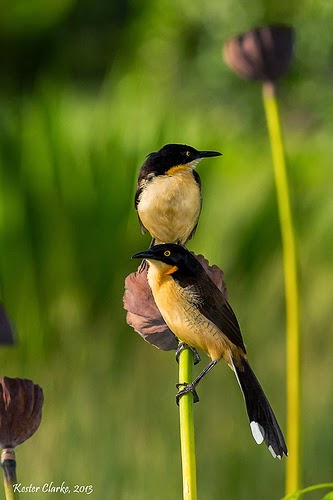
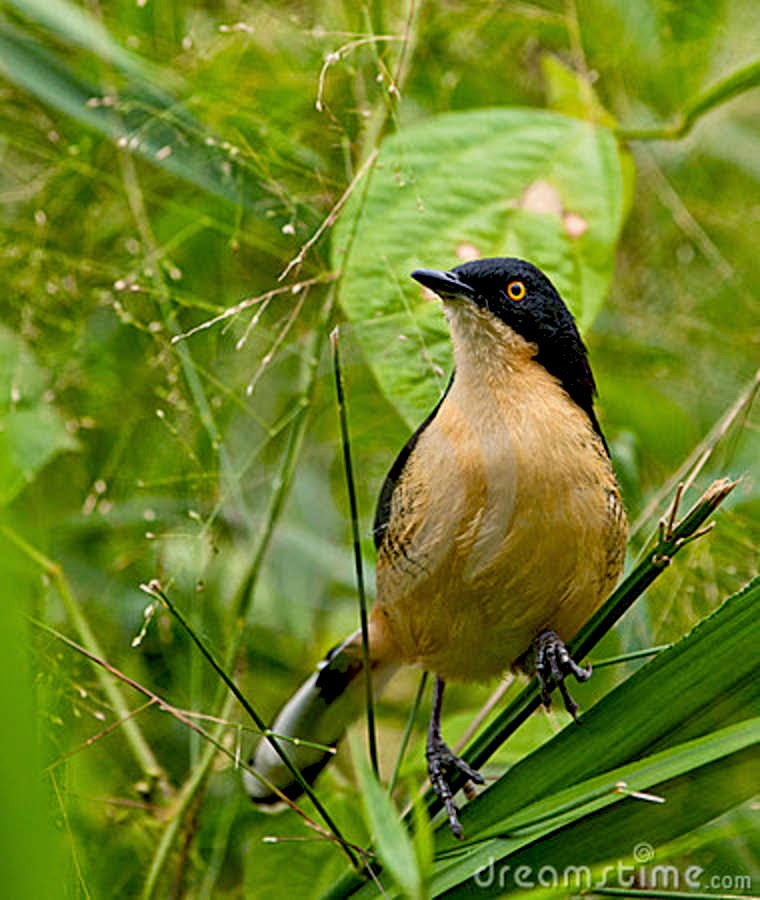
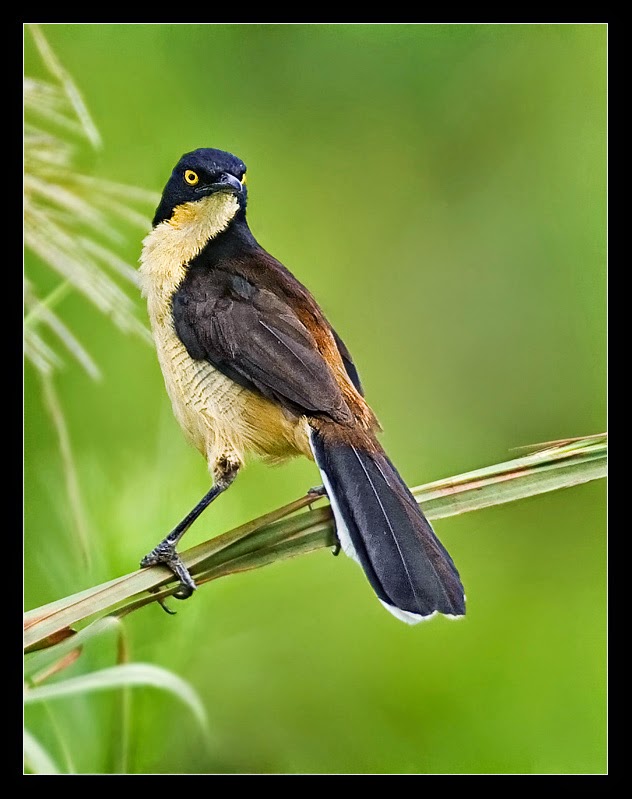
Black Capped Donacobius


Black Capped Donacobius - Mimik


Brazil, Pantanal, 2013

Description
The Black-capped Donacobius is a conspicuous, vocal South American bird. It is found in tropical swamps and wetlands in South America. It is unmistakable with a head and shoulders that are glossy black, a back that is more of a brown, and a rump that is olive-brown. Its tail feathers are black with noticeable white tips. Its wings are blackish with an obvious white flash at the bottom. The bird has underparts that are a warm yellow with black bars on its side. Its eyes are a bright yellow, and its legs are a dusky green. The black-capped donacobius also has a yellow cheek pouch that can puff out.


Habitat

Donacobius is resident along river edges with brushy areas and with invading dense vegetation in standing water. They need marshes for breeding. Black-capped Donacobiuses are common in a wide range of Amazonian wetlands.
Voice

Donacobius pair utters fascinating duets. Both perch close to each other, one above the other, and often facing each other. They call while bobbing their heads and wagging their fanned tails jerkily. The upper bird utters a hard “chrrr” and the other a loud “kweea”. At this time, we can often see the orange-yellow pouches exposed.
This melodious duet lasts some seconds, and it is used for to keep away potential intruders. Male gives series of liquid whistles and female utters a lower grating sound. Male’s call varies in intensity from slow repetitions of whistles to rapid bursts of notes when it is very excited.


Diet
Donacobius feeds mainly on invertebrates. It gleans from leaf surface in grass, and may also catch flying insects, from low perches over water. It forages in vegetation and grassy marshes where it probes and plugs insects. Donacobius is probably entirely resident in its range. Pairs live in narrow territories along water edges. A large portion consists of marshy edges.
Reproduction

Donacobius’s nest is built in vegetation, reeds or grass, often over standing water, at about 25 cm to one meter above water. But nest may be built in other places, and when it is not over water, nest is located higher, up to two meters above the ground. Nest is mainly built by female.
It is a bulky open cup (external sizes 10 to 15 cm) with a nesting cup of 6cm depth and 8 cm in diameter. Nest is made with grass, plant fibers, and other materials frequently added, such as snake skins and silk from spider webs and cocoons. Donacobius may also take some materials from nests of other species. Breeding occurs during rainy months.
Female lays 2 purplish-white eggs, heavily spotted with reddish and purplish. Incubation lasts about 16 to 18 days, by female alone. Altricial chicks are naked at hatching. Adults wet them with their own soaked feathers, after immersion into the water.
Young are fed by both parents, but also by helpers which are offspring from the last breeding season, or for one or two seasons before. Young fledge when they are 17 to 18 days old.
When nesting care is shared by pair and helpers, broods are more productive. Helpers assist breeding pair in defense of the territory, feeding young and guarding the nest.
This species seems to produce one single brood and a second clutch of replacement if the first is lost. But sometimes, pair may produce two broods per year. Mates stay together all their life.


Photos by others.


http://www.treknature.com/gallery/South_America/Peru/South/Madre_de_Dios/photo226561.htm

Credits

Avibase, Planetofbirds.com, Oiseoux-birds.com

Monday, April 28, 2014

Barred Owl


Barred Owl - Puszczyk kreskowany


Cresskill, New Jersey, 2013

Description
The Barred Owl (Strix varia) is a large typical owl native to North America. Best known as the Hoot Owl for its distinctive call, it goes by many other names, including Eight Hooter, Rain Owl, Wood Owl, and Striped Owl. It has a pale face with dark rings around the eyes, a yellow beak and brown eyes. It is the only typical owl of the eastern United States which has brown eyes; all others have yellow eyes. The upper parts are mottled gray-brown. The underparts are light with markings; the chest is barred horizontally while the belly is streaked vertically. The legs and feet are covered in feathers up to the talons. The head is round and lacks ear tufts, a distinction from the slightly smaller Short-eared Owl, which favors more open, marginal habitats.


Habitat

A nocturnal bird. Hides in dense foliage during the day, usually high up. May also roost on a branch close to a broad tree-trunk, or in a natural tree hole. May be very aggressive when defending a nest. Breeding habitats are dense woods across Canada, the eastern United States, and south to Mexico; in recent years it has spread to the northwestern United States, having gradually spread farther south in the west.
Voice

A loud barking hoo, hoo, hoo-hoo; hoo, hoo; hoo, hooo-aw! and a variety of other barking calls and screams.

Diet
Mostly small mammals. Eats many mice and other small rodents, also squirrels (including flying squirrels), rabbits, opossums, shrews, other small mammals. Also eats various birds, frogs, salamanders, snakes, lizards, some insects. May take aquatic creatures such as crayfish, crabs, fish.
Behavior: Hunts by night or day, perhaps most at dawn and dusk. Seeks prey by watching from perch, also by flying low through forest; may hover before dropping to clutch prey in talons. Like many other owls, coughs up pellets of its prey.

Reproduction

The Barred Owl's nest is often in a tree cavity, often ones created by pileated woodpeckers; it may also take over an old nesting site made previously by a red-shouldered hawk, cooper's hawk, crow, or squirrel. It is a permanent resident, but may wander after the nesting season. If a nest site has proved suitable in the past they will often reuse it as the birds are non-migratory. In the United States, eggs are laid from early-January in southern Florida to mid-April in northern Maine, and consist of 2 to 4 eggs per clutch. Eggs are brooded by the female with hatching taking place approximately 4 weeks later. Young owls fledge four to five weeks after hatching. These owls have few predators, but young, unwary owls may be taken by cats. The most significant predator of Barred Owls is the Great Horned Owl.[ The Barred Owl has been known to live up to 10 years in the wild and 23 years in captivity.
Did you know?
The belly feathers of some Barred Owls are pink. This coloring may be the result of eating a lot of crayfish. A barred owl's right ear is higher than its left ear. Hearing from two different angles helps it pinpoint the location of prey.

Photos by others

http://commons.wikimedia.org/wiki/File:Barred-owl-chick-58.jpg


Credits
Wikipedia, The Owl Pages

American Robin


American Robin - Drozd wędrowny


Cresskill, New Jersey, 2013


Description
The American Robin is the largest, most abundant, and most widespread North American thrush. The presence of this rather tame songster in the backyard setting, together with its loud and musical voice, makes it one of the most easily recognizable birds in North America. The head varies from jet black to gray, with white eye arcs and white supercilia. The throat is white with black streaks, and the belly and undertail feather are white. The Robin has a brown back and a reddish-orange breast, varying from a rich red maroon to peachy orange. The bill is mainly yellow with a variably dark tip, the dusky area becoming more extensive in winter, and the legs and feet are brown. The American Robin is active mostly during the day, and on its winter grounds it assembles in large flocks at night to roost in trees in secluded swamps or dense vegetation.

Habitat

This bird breeds throughout most of North America, from Alaska and Canada southward to northern Florida and Mexico. While Robins occasionally overwinter in the northern part of the United States and southern Canada, most migrate to winter south of Canada from Florida and the Gulf Coast to central Mexico, as well as along the Pacific Coast. Most depart south by the end of August and begin to return north in February and March. The American Robin's breeding habitat is woodland and more open farmland and urban areas. It becomes less common as a breeder in the southernmost part of the Deep South of the United States, and there prefers large shade trees on lawns. Its winter habitat is similar but includes more open areas.

Voice
The male American Robin, as with many thrushes, has a complex and almost continuous song. Its song is commonly described as a cheerily carol, made up of discrete units, often repeated, and spliced together into a string with brief pauses in between. The American Robin is often among the first songbirds singing as dawn rises or hours before, and last as evening sets in.

Diet
The American Robin's diet generally consists of around 40% invertebrates, such as earthworms, beetle grubs, caterpillars and grasshoppers, and 60 percent wild and cultivated fruits and berries. Robins forage primarily on the ground for soft-bodied invertebrates, and find worms by sight, pouncing on them and then pulling them up. Nestlings are fed mainly on worms and other soft-bodied animal prey.
Reproduction

The American Robin begins to breed shortly after returning to its summer range. It is one of the first North American bird species to lay eggs, and normally has two to three broods per breeding season, which lasts from April to July. The nest is most commonly located above the ground in a dense bush or in a fork between two tree branches, and is built by the female alone. The American Robin does not shy away from nesting close to human habitation and will frequently construct nests under eaves or awnings on human homes when such locations provide adequate shelter. Robins are not cavity nesters, and so will generally not use a bird house, but will take advantage of artificial nesting platforms that have been provided. A clutch consists of three to five light blue eggs, and is incubated by the female alone. The eggs hatch after 14 days, and the chicks leave the nest a further two weeks later. The altricial chicks are naked and have their eyes closed for the first few days after hatching. While the chicks are still young, the mother broods them continuously. When they are older, the mother will brood them only at night or during bad weather.

Did you know?


The American Robin is a known reservoir (carrier) for West Nile virus. While crows and jays are often the first noticed deaths in an area with West Nile virus, the American Robin is suspected to be a key host, and holds a larger responsibility for the transmission of the virus to humans. This is because while crows and jays die quickly from the virus, the American Robin survives the virus longer, hence spreading it to more mosquitoes, which then transmit the virus to humans and other species.

The American Robin has a place in Native American mythology. The story of how the robin got its red breast by fanning the dying flames of a campfire to save a Native American man and a boy.


Credits
Wikipedia, Avibase

Friday, April 18, 2014

American Oystercatcher


American Oystercatcher - Ostrygojad brunatny

New York, Canarsie, 2013
Description

The American Oystercatcher has distinctive black and white plumage and a long, bright orange beak. The head and breast are black and the back, wings and tail greyish-black. The underparts are white, as are feathers on the inner part of the wing which become visible during flight. The irises are yellow and the eyes have orange orbital rings. The legs are pink.

Habitat

The American Oystercatcher is found on the Atlantic coast of North America from New England to northern Florida, where it is also found on the Gulf coast, and south to Brazil, Uruguay and Argentina. In the 19th century they became locally extinct in the northeast of the United States due to market hunting and egg collecting. The American Oystercatcher is common in coastal salt marshes and sand beaches throughout the central part of its range. One of the few birds to specialize on bivalve mollusks living in saltwater, this species is completely restricted to marine habitats. Although this oystercatcher inhabits coastal areas where human encroachment, habitat loss, and destruction are threats, the recent establishment of large coastal reserves helps to protect the center of its abundance. This species adapts well to dredge spoil islands, and is often the most common breeder in such locations.


Voice

Diet

Oystercatchers are closely tied to coastal habitats. They nest on beaches on coastal islands and feed on marine invertebrates. The large, heavy beak is used to pry open bivalve mollusks. Feeds mostly on mussels, clams, oysters; also marine worms, sand crabs, limpets, and other small creatures of the intertidal zone. Often forages by walking in shallow water, searching for food by sight. Finding an oyster or mussel with its shell open, the oystercatcher quickly jabs its bill into the shell, cutting the muscles and then cleaning out contents. May also take a closed mussel and hammer it open. Probes in mud for clams and other items, and pries limpets off rocks.
Reproduction
Sometimes may mate for life. In courtship display, two birds walk and then run side by side, giving loud piping calls; may take off and fly together. Sometimes may form trios, with one male and two females attending one nest or two nearby nests. Site is on ground, on marsh island or among dunes, above high tide mark. Nest (apparently built by both sexes) is shallow scrape in sand, sometimes lined with pebbles, shells.

Photos by others


Credits
birds.audubon.org, planetofbirds.com, Wikipedia, Avibase

Monday, April 14, 2014

Bearded Woodpecker

Bearded Woodpecker - Dzięcioł Sawannowy


Africa, Botswana, Okavango Delta, 2012


Description
The four savanna woodpecker species are superficially very alike in appearance and coloration and therefore misidentifications would have occurred, but probably somewhat less frequently in case of the Bearded Woodpecker which is noticeably larger and his similar bold facial markings in both the male and female. It also has distinctive drumming behavior which renders it conspicuous, and this may account for its comparatively high reporting rates. The sexes look very similar, except that the males have a small red patch on the back of their head.

Habitat

The Bearded woodpecker occurs from central Africa to southern Africa. It dislikes dense forest, preferring deciduous woodland and savanna. Any broad-leaved woodland in which there are tall trees, especially dead trees, is optimum habitat for this woodpecker.
Voice

Diet
It mainly forages in trees, tapping and probing branches in search of insects, licking them up with its barbed tongue. The following food items have been recorded in its diet: beetle larvae and pupae, Mopane emperor moth larvae, termite, spiders, lizards.
Reproduction

 Both sexes excavate the nest, which is usually a oval-shaped hole in the trunk of a tree, although it has been recorded nesting in fence posts. Here It lays 1-3 eggs, which are incubated by both sexes, for roughly 13 days. The chicks are cared for by both parents, leaving the nest at about 27 days old. The juveniles become fully independent roughly 1-2 months after fledging.

Did you know?

Because woodpeckers beat on trees with their powerful beaks to collect food, to construct their nests and to communicate with each other, they have evolved a number of anatomical features to prevent brain damage from repeated blows to their heads. These include small brain size, the orientation of the brain within the skull, which maximizes the contact area between the brain and the skull to keep it from rattling around inside the head. Additionally, in that millisecond before contact with wood, a thickened nictitating membrane closes, protecting the eyes from flying debris. Even their nostrils are protected; they are often slit-like and have special bristles that cover them.

Photos by others


Credits
Biodiversity Explorer