Fan Of Birds

Fan Of Birds

Friday, January 9, 2015

Snowy Egret


Snowy Egret - Czapla śnieżna


New York, Jamaica Bay, 2014
 
Description
 
Adults are typically 61 centimeters (24 in) long and weigh 375 grams (13.2 oz.)

They have a slim black bill and long black legs with yellow feet. The area of the upper bill, in front of the eyes, is yellow but turns red during the breeding season, when the adults also gain recurved plumes on the back, making for a "shaggy" effect.

The juvenile looks similar to the adult, but the base of the bill is paler, and a green or yellow line runs down the back of the legs.


Habitat

Snowy Egrets nest in colonies on thick vegetation in isolated places—such as barrier islands, dredge-spoil islands, salt marsh islands, swamps, and marshes. They often change location from year to year. During the breeding season Snowy Egrets feed in estuaries, saltmarshes, tidal channels, shallow bays, and mangroves. They winter in mangroves, saltwater lagoons, freshwater swamps, grassy ponds, and temporary pools, and forage on beaches, shallow reefs, and wet fields.

Voice

 Snowy Egrets are quiet except on breeding sites, where they give raspy or nasal calls, including loud, harsh squawks to signal aggression.

Diet
 
The Snowy Egret eats mostly aquatic animals, including fish, frogs, worms, crustaceans, and insects. It often uses its bright yellow feet to paddle in the water or probe in the mud, rounding up prey before striking with its bill. Snowy Egrets feed while standing, walking, running, or hopping, and they may vibrate their bills, sway their heads, or flick their wings as part of prey gathering. They even forage while hovering. Snowy Egrets forage in saltmarsh pools, tidal channels, tidal flats, freshwater marshes, swamps, ocean inlets, and lake edges, usually preferring brackish or marine habitats with shallow water. Other foraging water birds often assemble around them to form mixed-species foraging groups.
Reproduction

   The male starts working on a nest before finding a mate. Then the female takes over and ends up doing most of the nest building, with materials supplied by the male. The nest is a shallow oval of loosely woven twigs, small sticks, grasses, sedges, rushes, and Spanish moss, about 14–18 inches across and 8–13 inches high. Three to four greenish-blue, oval eggs are incubated by both adults. The young leave the nest in 20 to 25 days and hop about on branches near the nest before finally departing.
    Males establish nesting territories and choose nest sites within the thick vegetation of a breeding colony. The nest is usually in the top or outer branches of a woody vine, shrub, or tree.
    Male Snowy Egrets fight for breeding territories, choose nest sites, and perform noisy courtship displays to attract mates. A ring of other egrets often gathers around a displaying male as he pumps his body up and down, points his bill skyward, and calls. He also performs aerial displays, including one that ends with him dropping toward the ground while tumbling around and around. After pairing up, Snowy Egrets continue defending the immediate area around the nest, raising their crests and giving rasping calls. Some of their nest predators include raccoons, Great Horned Owls, Barred Owls, American Crows, Fish Crows, American alligators, and gray rat snakes. Highly social all year long, Snowy Egrets forage with gulls, terns, ibises, and other herons, and they nest in colonies alongside many other species, including Great Egrets, night-herons, Glossy Ibises, Little Blue Herons, Tricolored Herons, Cattle Egrets, and Roseate Spoonbills.



Did you know?

      Male and female Snowy Egrets take turns incubating their eggs. As one mate takes over for the other, it sometimes presents a stick, almost as if passing a baton. Both parents continue caring for the young when they hatch.

      During the breeding season, adult Snowy Egrets develop long, wispy feathers on their backs, necks, and heads. In 1886 these plumes were valued at $32 per ounce, which was twice the price of gold at the time. Plume-hunting for the fashion industry killed many Snowy Egrets and other birds until reforms were passed in the early twentieth century. The recovery of shorebird populations through the work of concerned citizens was an early triumph and helped give birth to the conservation movement.

     Adult Snowy Egrets have greenish-yellow feet for most of the year, but at the height of the breeding season their feet take on a much richer, orange-yellow hue. The bare skin on their face also changes color, from yellow to reddish.

     Snowy Egrets sometimes mate with other heron species and produce hybrid offspring. They have been known to hybridize with Tricolored Herons, Little Blue Herons, and Cattle Egrets.
The oldest Snowy Egret on record was at least 17 years, 7 months old.


Photos by others


Ian Barker


Ron Reznick


Credits
 Cornell Lab of Ornithology

Thursday, January 8, 2015

Grey Loerie


Grey Loerie - Hałaśnik Szary


Africa, Botswana, 2012
 
Description


The grey Loerie (Corythaixoides concolor) is also known by the name of “go-away” bird or in Afrikaans, “kwêvoël” . The Grey Go-away-bird has a height of 50 cm and weighs around 270 gm. The head is colored grey while the bill is colored black. The Corythaixoides concolor has a grey throat, black legs and a grey back. The eyes are brown. Has a prominent crest which is raised and lowered when alarmed. It occurs in dry woodland and wooded suburban environments where it can often be seen on a conspicuous perch from where it will give it’s well known call. This behavior does not endear this bird to hunters who, after an arduous stalk to get close enough to an animal to get a shot, often “have their cover blown” and their presence betrayed by a call which does not sound unlike the words “go away”.

They usually occur in pairs or small parties that are highly vocal, especially when disturbed. They fly at fairly low altitudes and have a characteristic flight pattern consisting of slow, floppy wing beats interspersed with gliding.

The Grey Go-Away Bird is a member of the turaco family. It is found in Southern Africa and is one of the least colorful turaco’s, many of which are as colorful as parrots. The Grey Go-Away is named for its call and it is a very social bird, often living in groups of up to 30 birds.


Habitat


The bird is found in the arid and semi-arid regions of Southern Africa and it can withstand high day and night temperatures.
The bird is an urban dweller as well, being at home in parks, gardens and in old vacated buildings.
    These birds are quick and agile and clamber about in the foliage of trees in their search for fruits and flowers which make up the bulk of their diet. They are particularly fond of the flowers of Acacia Robusta and of the fruits of the jackal berry. It has a preference for open thorn bush country, often near water.


Voice

It has a distinctive loud alarm call "quare", fancifully sounding like "go away".

Diet
    It eats fruit, leaves and insects. In captivity, it tends to prefer grains and leaves rather than fruit.
The Grey Go-away-bird is usually seen hunting for food within the tree foliage.
This bird eats insects such as butterflies, bees, wasps, locusts and ants. These invertebrates are usually hawked aerially, killed and then eaten.

 
Reproduction
      The Grey Go-away-bird is a monogamous bird which means that the bird finds and breeds with one partner for the rest of its life. The bird lays between 1 to 4 eggs and they are colored blue. They breed throughout the year. Their nests are flimsy, unlined saucers made of twigs built in the upper central branches of trees. The clutch averages three eggs which is incubated by both parents. Young fledglings are fed by both parents and sometimes a helper as well. Grey Loerie tend to be silent in the vicinity of their nests which is in contrast to their noisy response when approached at other times.


Photos by others


 Mosetlha Bush Camp
 
 
Robert Erasmus


Credits
  Wikipedia

Crimson Crested Woodpecker


Crimson Crested Woodpecker - Dzięcioł szkarłatnoczuby


 Brazil, Pantanal, 2013
 
Description
    Crimson-crested Woodpecker occurs regularly from Panama south to northern Argentina and throughout Amazonia. It is a very large, robust woodpecker with a large red crest. The male is distinguished from other co-occurring large woodpeckers by the combination of barred underparts and an entirely red head that lacks facial stripes, and has only a suggestion of a black-and-white "slash" below the eye. Females have a black front to the crest, and a very broad white malar stripe that continues into the white strip down the neck.
 
Habitat

  Crimson-crested Woodpecker is often seen in pairs or in small groups of 4 or 5 birds in the same large dead tree. Found in almost every habitat ( from forest to forest edge and light woodland) with large dead trees, except urban areas.

Voice

  The call of this widespread but wary bird is a loud, ringing CHEE-sic. Both sexes drum.

Diet
  This woodpecker performs long flights from tree to tree, in order to explore the trunks, branches and bark for food. Crimson-crested Woodpecker moves on the underside of limbs, or hangs upside-down on branches. Crimson-crested woodpeckers chip out holes, often quite large, while searching out insects in trees. They mainly eat wood-boring insects and larvae, as well as ants, termites, small vertebrates and caterpillars. The animal matter is sometimes supplemented with berries. Several of these large woodpeckers may be seen (4 or more) attracted to the same dead tree while feeding.
Reproduction
Breeding season depends on the locality.
During breeding season, Crimson-crested Woodpecker performs some displays with erect crest, while it swings the head. These displays are accompanied by calls. These calls are low and uttered just before copulation, and when the birds take turns during incubation at nest. These calls strengthen the pair bonds.
However, between two rivals, the calls are louder, even if this species is rather silent. During these disputes, males give shrill piping lacking several minutes. Then, the intruder is chased away from the territory, or both males fight in flight.
Crimson-crested Woodpecker nests in holes excavated by both adults, relatively high in trees or stubs. The entrance is fairly large, about 45 to 50 cm in diameter, and oval-shaped.
Female lays 2 to 3 white eggs, sometimes four. Incubation lasts about 9 to 14 days, by both sexes. Woodpeckers have short incubation period, but at contrary, nesting period is longer than in other birds’ species. Chicks are brooded and fed by both parents, and remain at nest for 3 to 4 weeks after hatching. Young remain within the family group until next breeding season.


Photos by others
 
 
Dan Busby

 
Homin Lin

 
Walt Barrows


Credits
Oiseaux-birds, Wikipedia

Friday, October 3, 2014

Sacred Ibis

Sacred Ibis - Ibis czczony


 Tanzania, 2014
 
Description
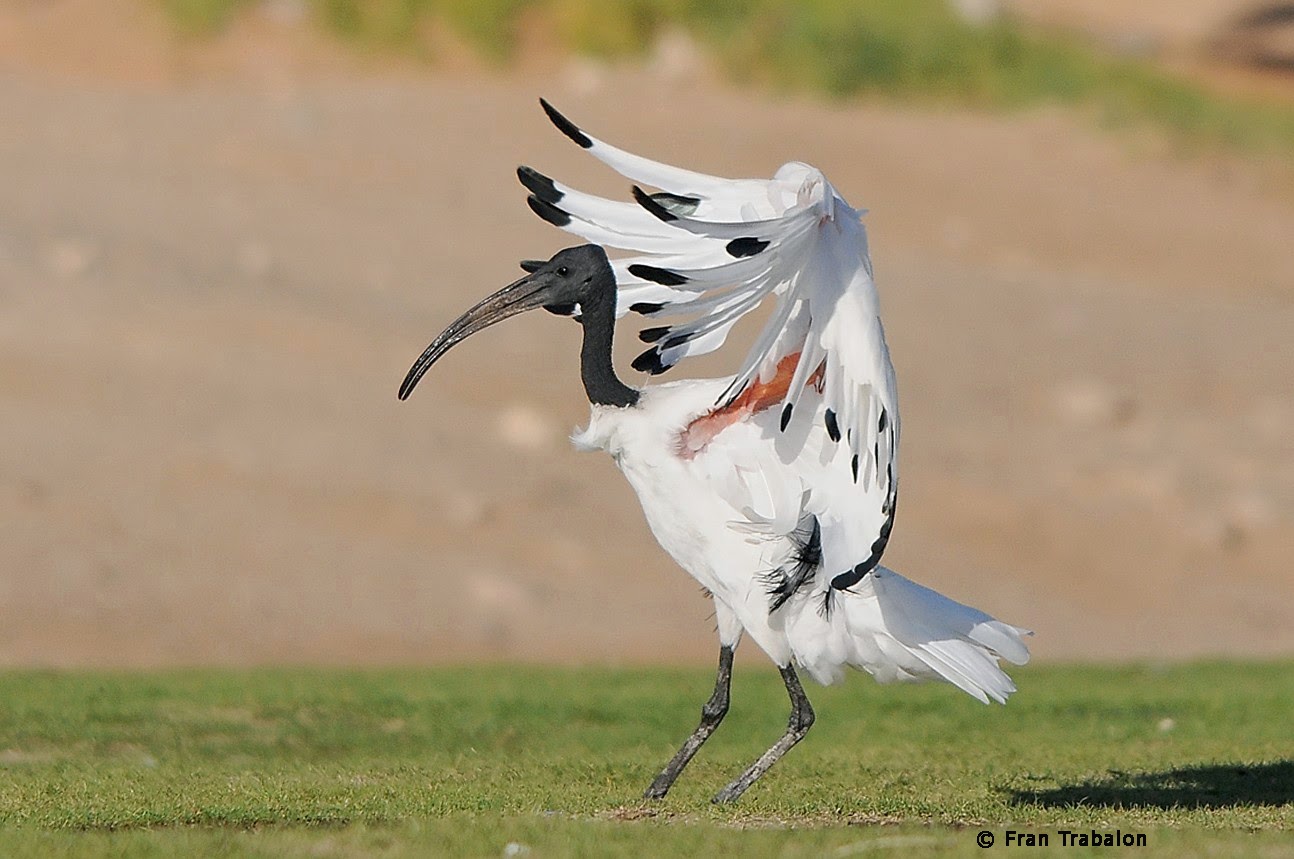
The distinctive African sacred ibis is characterized by its large size, primarily white plumage and conspicuous black head and neck, which lack feathers. One of the most prominent features of this bird is its long, black, down curved bill, which has a neck sac positioned underneath its lower surface and is used for probing into soft mud and sand in pursuit of prey. The male and female African sacred ibis are similar in appearance, although males are larger than females and frequently have a longer bill. The sacred ibis breeds in north from South Africa to Sudan and Niger. But is absent in may regions within Cameroon, Congo, Gabon and the Central African Republic. This species was formerly found in Egypt, although it is now thought to be regionally extinct there. Nomadic or migratory. Movements of several hundred kilometers to breed during rains; birds N of equator move northwards, those S of equator southwards, both returning at end of rains or early in dry season. 


Habitat

The African sacred ibis is found in a wide range of habitats, including freshwater wetlands, salt pans, dams, mangroves, rivers in open forested areas, and cultivated fields. Human environments are also inhabited by this species and it is frequently found around refuse dumps, abattoirs and farmyards. In Zambia, it has been recorded up to elevations of 1,800 meters.
Voice

    The vocalizations of the African sacred ibis are highly variable, with harsh croaking noises being made during flight and squeaking ‘whoot-whoot-whoot-whooeeoh’ or ‘pyuk-pyuk-peuk-peuk-pek-peuk’ calls made while individuals are on their breeding grounds. Vocalizations are also used by females to attract males and during copulation.

Diet
    An opportunistic, mainly carnivorous feeder, the African sacred ibis takes a range of insects, worms, bird and reptile eggs, crustaceans, frogs, lizards, small mammals and carrion. It uses its long bill to probe into mud and soil to capture prey, as well as chasing moving prey with its wings half open. Certain populations forage around rubbish dumps and slurry pits, with some becoming reliant on these areas as a food source.
Reproduction
      The breeding season of the African sacred ibis differs geographically, but usually begins during or shortly after the rainy season. Large, mixed-species colonies are formed, which include between 50 and 2,000 breeding pairs. The male collects the nest materials and the female assembles the structure. The nest is a large platform of sticks and branches, which is lined with leaves and grass and placed in a tree, bush or on the ground. When nest materials are in short supply, males may attempt to steal objects from other individuals within the colony. Once the nest is complete, the female African sacred ibis then lays an average clutch of two or three eggs, which have a rough surface and are dull white with a blue or green tinge and red-brown spots. The male and female take turns to incubate the eggs, usually changing over every 24 hours. The incubation period lasts around 28 days, after which the nestlings are fed and cared for by both adults, with one finding food while the other remains at the nest. The nestlings eventually fledge the nest when they are between 35 and 40 days old. A fledgling will leave its colony when it is between 44 and 48 days old. The pair bond between the male and female African sacred ibis lasts for one breeding season.


Photos by others
 
 
www.templeilluminatus.com

 
ibc.lynxeds.com

 
galleryhip.com


Credits

Tuesday, August 12, 2014

White Stork


White Stork - Bocian biały


 Brazil, Pantanal, 2013
Description
 
    The white stork is a gregarious bird; flocks of thousands of individuals have been recorded on migration routes and at wintering areas in Africa. Non-breeding birds gather in groups of 40 or 50 during the breeding season.

    White storks fly south from their summer breeding grounds in Europe in August and September, heading for Africa. There, they spend the winter in savannah from Kenya south to the South Africa. In these areas they congregate in large flocks which may exceed a thousand individuals. Some diverge westwards into western Sudan and Chad, and may reach Nigeria. In spring, the birds return north; they are recorded from Sudan and Egypt from February to April. They arrive back in Europe around late March and April, after an average journey of 49 days. By comparison, the autumn journey is completed in about 26 days. Tailwinds and scarcity of food and water en route (birds fly faster over regions lacking resources) increase average speed. Due to its large size, predation on vermin, and nesting behaviour close to human settlements and on rooftops, the white stork has an imposing presence that has had an impact on human culture and folklore.

    A white stork's droppings, containing faeces and urine, are sometimes directed onto its own legs, making them appear white. The resulting evaporation provides cooling and is termedurohidrosis. Birds that have been ringed can sometimes be affected by the accumulation of droppings around the ring leading to constriction and leg trauma. The white stork has also been noted for tool use by squeezing moss in the beak to drip water into the mouths of its chicks.

 
Habitat


    The white stork has a wide range across Europe, clustered in the Iberian Peninsula and North Africa in the west, and much of eastern and central Europe, with 25% of the world's population concentrated in Poland.

    The white stork's preferred feeding grounds are grassy meadows, farmland and shallow wetlands. It avoids areas overgrown with tall grass and shrubs. In parts of Poland, poor natural foraging grounds have forced birds to seek food at rubbish dumps since 1999. White storks have also been reported foraging in rubbish dumps in the Middle East, North Africa and South Africa.

    The white stork breeds in greater numbers in areas with open grasslands, particularly grassy areas which are wet or periodically flooded, and less in areas with taller vegetation cover such as forest and shrub land. They make use of grasslands, wetlands, and farmland on the wintering grounds in Africa.

Voice

    The adult white stork's main sound is noisy bill-clattering, which has been likened to distant machine gun fire. The bird makes these sounds by rapidly opening and closing its beak so that a knocking sound is made each time its beak closes. The clattering is amplified by its throat pouch, which acts as a resonator. Used in a variety of social interactions, bill-clattering generally grows louder the longer it lasts, and takes on distinctive rhythms depending on the situation—for example, slower during copulation and briefer when given as an alarm call. The only vocal sound adult birds generate is a weak barely audible hiss; however, young birds can generate a harsh hiss, various cheeping sounds, and a cat-like mew they use to beg for food. Like the adults, young also clatter their beaks.

Diet
    White storks consume a wide variety of animal prey. They prefer to forage in meadows that are within roughly 5 km of their nest and sites where the vegetation is shorter so that their prey is more accessible. Their diet varies according to season, locality and prey availability. Common food items include insects (primarily beetles, grasshoppers, locusts and crickets), earthworms, reptiles, amphibians, particularly frog species such as the edible frog and common frog and small mammals such as voles, moles and shrews. Less commonly, they also eat bird eggs and young birds, fish, molluscs, crustaceans and scorpions. They hunt mainly during the day, swallowing small prey whole, but killing and breaking apart larger prey before swallowing. Rubber bands are mistaken for earthworms and consumed, occasionally resulting in fatal blockage of the digestive tract.
Reproduction
      The white stork breeds in open farmland areas with access to marshy wetlands, building a large stick nest in trees, on buildings, or on purpose-built man-made platforms. Nests are built in loose colonies. The nest is typically used year after year especially by older males. The males arrive earlier in the season and choose the nests. Larger nests are associated with greater numbers of young successfully fledged, and appear to be sought after. Nest change is often related to a change in the pairing and failure to raise young the previous year, and younger birds are more likely to change nesting sites. Although a pair may be found to occupy a nest, partners may change several times during the early stages and breeding activities begin only after a stable pairing is achieved.
      Paired birds greet by engaging in up-down and head-shaking crouch displays, and clattering the beak while throwing back the head. Pairs copulate frequently throughout the month before eggs are laid. A white stork pair raises a single brood a year. The female typically lays four eggs, though clutches of one to seven have been recorded. Incubation begins as soon as the first egg is laid, so the brood hatches asynchronously, beginning 33 to 34 days later. The first hatchling typically has a competitive edge over the others. While stronger chicks are not aggressive towards weaker siblings, as is the case in some species, weak or small chicks are sometimes killed by their parents. This behaviour occurs in times of food shortage to reduce brood size and hence increase the chance of survival of the remaining nestlings. White stork nestlings do not attack each other, and their parents' method of feeding them (disgorging large amounts of food at once) means that stronger siblings cannot outcompete weaker ones for food directly, hence parental infanticide is an efficient way of reducing brood size. Despite this, this behaviour has not commonly been observed.


Did you know?


Storks have little fear of humans if not disturbed, and often nest on buildings in Europe. In Germany, the presence of a nest on a house was believed to protect against fires. They were also protected because of the belief that their souls were human.

According to European folklore, the stork is responsible for bringing babies to new parents. The legend is very ancient, but was popularised by a 19th century Hans Christian Andersen story called The Storks.
German folklore held that storks found babies in caves or marshes and brought them to households in a basket on their backs or held in their beaks. These caves contained adebarsteine or “stork stones”. The babies would then be given to the mother or dropped down the chimney. Households would notify when they wanted children by placing sweets for the stork on the window sill. From there the folklore has spread around the world to countries such as the Philippines and South America.

 In Slavic mythology and religion, storks were thought to carry unborn souls from Iriy to Earth in spring and summer. This belief still persists in the modern folk culture of many Slavic countries, in the simplified child story that “storks bring children into the world”. Storks were seen by the Slavs as bringing luck, and killing one would bring misfortune. A long-term study that showed a spurious correlation between the numbers of stork nests and human births is widely used in the teaching of basic statistics as an example to highlight that correlation does not necessarily indicate causation. The child-bringing myth has appeared in different forms in history. Children of African American slaves were sometimes told that white babies were brought by storks, while black babies were born from buzzard eggs.

 There were negative aspects to stork folklore as well; a Polish folk tale relates how God made the stork’s plumage white, while the Devil gave it black wings, imbuing it with both good and evil impulses. They were also associated with handicapped or stillborn babies in Germany, explained as the stork having dropped the baby en route to the household, or as revenge or punishment for past wrongdoing. A mother who was confined to bed around the time of childbirth was said to have been “bitten” by the stork. In Denmark, storks were said to toss a nestling off the nest and then an egg in successive years. In medieval England, storks were also associated with adultery, possibly inspired by their courtship rituals. Their preening and posture saw them linked with the attribute of self-conceit.

Photos by others

www.stefanoronchi.com
 
 
www.Pbase.com
 

Dalyanbirding's Blog


Credits
Planet of Birds, Wikipedia


Wednesday, July 30, 2014

Jabiru

Jabiru - Żabiru amerykański


 Brazil, Pantanal, 2013
Description
The Jabiru Stork is a very rare bird and is endangered throughout its range. It is the tallest flying bird found in South America and, often standing around the same height as the flightless and much heavier American rhea, and has the second largest wingspan, after the Andean condor. Large males may stand as tall as 1.53 m (5.0 ft.). The beak is black and broad, slightly upturned, ending in a sharp point. The plumage is mostly white, but the head and upper neck are featherless and black, with a featherless red stretchable pouch at the base. The sexes are similar in appearance but the male is larger, which can be noticeable when the sexes are together. While it can give the impression of being an ungainly bird on the ground, the jabiru is a powerful and graceful flier.


Habitat

The Black-necked Stork inhabits wetlands, such as floodplains of rivers with large shallow swamps and pools, and deeper permanent bodies of water. Occasionally individuals will stray into open grass, woodland areas or flooded paddocks in search of food.
Voice

Diet
Jabiru eats prodigious quantities of fish, molluscs, and amphibians. It will occasionally eat reptiles, bird eggs and small mammals. It will even eat fresh carrion and dead fish, such as those that die during dry spells, and thus help maintain the quality of isolated bodies of water. They feed in flocks and usually forage by wading in shallow water. Jabirus detect prey more through tactile sensation than vision. They feed by holding their open bill at a 45 degree angle to the water. When prey is contacted, the storks close their bill, draw it out of the water, and throw their head back to swallow. It is an opportunistic feeder. In one instance when house mice experienced a population explosion in an agricultural area, and several hundred jabirus could be seen in each field feeding on the rodents (unusual for a bird that's rarely seen in large numbers anywhere). On rare occasions, jabirus have been seen attempting to kleptoparasitize the two smaller storks it co-exists with, the wood and maguari storks.
Reproduction
The nest of sticks is built by both parents around August–September on tall trees, and enlarged at each succeeding season growing to several meters in diameter. Nests are often deeper than they are wide, they can be up to 1 m (3.3 ft.) wide and 1.8 m (5.9 ft.) deep. Half a dozen nests may be built in close proximity, sometimes among nests of herons and other birds. The parents take turns incubating the clutch of two to five white eggs and are known to more territorial than usual against other jabirus during the brooding period. Raccoons and other storks (including their own species) are occasion predators of jabiru eggs, but most nest predators appear to avoid these huge-billed birds and there are no known predators of healthy adult jabirus. Although the young fledge around 110 days old, they often spend around another 3 months in the care of their parents. Because of this long length of time spent brooding, pairs have difficulty breeding in successive years. Less than half of active pairs in one season are active the next season. Only 25% of successful pairs are successful the next season. The lifespan average is 36 years.

Did you know?

The name of the Jaribu comes from the Tupi-Guarani language and means "swollen neck".
A nickname for the Jabiru is "Garzon Soldier".
Story from Australia where Jabiru was widespread :

Long time ago Jabiru and Brolga were sisters and like all sisters they fought. When their cousin the Emu tried to get in between a fight one day she got hurt and her blood made the head of the brolga red and the neck of the Jabiru likewise.


Photos by others
Donald and Esther's Travels

safaritalk.net


Credits
Wikipedia