Fan Of Birds

Fan Of Birds

Thursday, July 10, 2014

Saddle-billed Stork


Saddle-billed  Stork - Żabiru afrykański


Africa, Botswana, 2012

Description


It is spectacularly plumaged, identical in male and female when perched but the female shows much more white in the primaries in flight. The head, neck, back, wings, and tail are iridescent black, with the rest of the body and the primary flight feathers being white. Juveniles are browner grey in plumage. The massive bill is red with a black band and a yellow frontal shield (the "saddle"). The legs and feet are black with pink hocks. On the chest is a bare red patch of skin, whose color darkens during breeding season.

This is a huge bird that regularly attains a height of 59 in, a length of 56 in and a 7.9–8.9 ft. wingspan. The male is larger and heavier than the female, with a range of 11–17 lb. It is probably the tallest of the
storks (though not the heaviest), due in no small part to it extremely long legs (tarsus length is up to 14.4 in)). The long bill measures from 10.7 to 14.2 in. The sexes can be readily distinguished by the golden yellow irises of the female and the brown irises and dangling yellow wattles of the male. When in flight, they extend their necks to full length, drooping their heads slightly under the weight of the bill. This gives them a rather unique appearance.


Habitat

It inhabits extensive fresh, brackish or alkaline wetlands in open, semi-arid areas and savanna, with relatively high abundances of fish and with large trees nearby for nesting and roosting (although it avoids deeply forested areas). Suitable habitats include shallow freshwater marshes, wet grasslands, the margins of large or small rivers, lake shores, pans and flood-plains.

Voice

They are silent except for bill-clattering at the nest.

Diet
The saddle-billed stork, like most of its relatives, feeds mainly on fish, frogs and crabs, but also on small birds and reptiles. They move in a deliberate and stately manner as they hunt, in a similar way to the larger herons.

Reproduction

These storks are most frequently found in pairs and are very territorial. They communicate by clattering their bill at the nest occasionally, but are otherwise rather quiet. The Saddle-billed Stork pairs for life, and will reuse their nest. The male and the female birds work together to construct their nest. They will choose the top boughs of a tree that is situated near to wetlands as the safest spot to hatch and rear their young. This is no mean feat as the nest has to be rather large, since it needs to accommodate the whole bird in a sitting position. The female stork lays between one and five eggs. The chicks are fed by both parents, and reach fledgling age at between 58 and 100 days old. Both members of the pair incubate the eggs for between 32 and 35 days. The longest lifespan of a Saddle-billed Stork in captivity is just over 30 years.
Photos by others.

commons.wikimedia

Dean J. Tatooles

JOS WANTEN


Credits

SA-Venues.com , Wikipedia, 

Friday, July 4, 2014

Cocoi Heron


                                                         Cocoi Heron - Czapla czarnobrzucha


Brazil, Pantanal, 2013

Description
Best known of the typical herons are the very large, long-legged and long-necked, plain-hued, crested members of the genus Ardea The species of the Ardeidae (heron) family are mainly tropical birds, but they have spread out all over the world and occupy all but extremely high latitudes and elevation. Most members of this almost worldwide group breed colonially in trees, building large stick nests. Northern species such as Great Blue, Grey and Purple Herons may migrate south in winter, although the first two do so only from areas where the waters freeze. These are powerful birds with large spear-like bills, long necks and long legs, which hunt by waiting motionless or stalking their prey in shallow water before seizing it with a sudden lunge. They have a slow steady flight, with the neck retracted as is characteristic of herons and bitterns; this distinguishes them from storks, cranes, and spoonbills, which extend their necks.


Habitat

The Cocoi Heron frequents a great variety of wetlands, both fresh and salt water. It can be seen in shallow swamps, open wetlands, mangroves, rivers, lake shores, coastal mudflats and estuaries.
It usually avoids the inland dense forest and the arid coasts, preferring the marshy areas with forested fringes.
This species usually occurs in lowlands, but it can be seen up to 2550 meters of elevation and more in Colombia and Bolivia.

Generally sedentary, though birds in extreme South of range probably migrate North during winter. Also some post-breeding dispersal. Occasionally reaches Strait of Magellan and Lake Kami in far South. Non-breeding visitor to Trinidad mainly Jan-Jun. Accidental to Falklands and Gough Island. Usually sedentary bird in Suriname, some post breeding dispersal.
Voice

The Cocoi Heron utters guttural calls, either at roost and at colonies, or in flight “gawk uk, guk uk, guk uck uck” in more or less long series.

Diet
The Cocoi Heron feeds on fish, amphibians and aquatic insects, but according to the range, it may take other food items such as dead or dying animals, and mainly large fish of about 20 cm long.


Reproduction

The breeding season varies with the range, in July in Surinam, and between August and November in Brazil and Argentina.
The Cocoi Heron is a colonial breeder and nests in large colonies, sometimes with other species.
The nest is a deep cup made with sticks, twigs and reeds, and lined with grass. It is placed in trees or bushes.

The female lays 3-4 pale blue eggs with white markings. The incubation lasts 24-26 days, by both parents. The young birds remain at nest during a maximum of 12-13 weeks, but they wander off from the nest at about 6-7 weeks of age.


Photos by others.


Photo by Steve Mandel

verdeverdugo.blogspot.com


furandfeathers5000.blogspot


Credits

Oiseaux-birds.com, Planetofbirds, Avibase

Hyacinth Macaw


                                                        Hyacinth Macaw - Modroara hiacyntowa


Brazil, Pantanal, 2013

Description
The Hyacinth Macaw (Anodorhynchus hyacinthinus), or Hyacinthine Macaw, is a parrot native to central and eastern South America. With a length (from the top of its head to the tip of its long pointed tail) of about 100 cm (3.3 ft.) it is longer than any other species of parrot. It is the largest macaw and the largest flying parrot species, though the flightless Kakapo of New Zealand can outweigh it at up to 3.5 kg. While generally easily recognized, it can be confused with the far rarer and smaller Lear's Macaw. Habitat loss and trapping wild birds for the pet trade has taken a heavy toll on their population in the wild. The tail is long and pointed. Its feathers are entirely blue, lighter above. However, sometimes, the neck feathers can be slightly grey.


Habitat
The Hyacinth Macaw survives today in three main populations in South America: In the Pantanal region of Brazil, and adjacent eastern Bolivia and northeastern Paraguay, in the Cerrado region of the eastern interior of Brazil, and in the relatively open areas associated with the Tocantins River,Xingu River, Tapajos River, and the Marajo island in the eastern Amazon Basin of Brazil. It is possible that smaller, fragmented populations occur in other areas. It prefers palm swamps, woodlands, and other semi-open wooded habitats. It usually avoids dense humid forest, and in regions dominated by such habitats, it is generally restricted to the edge or relatively open sections (e.g. along major rivers). In different areas of their range these parrots are found in savannah grasslands, in dry thorn forest known as caatinga, and in palm stands, particularly the Moriche Palm.

Voice


Diet
The majority of the hyacinth macaw diet is nuts from native palms, such as acuri and bocaiuva palms. They have a very strong beak for eating the kernels of hard nuts and seeds. Their strong beaks are even able to crack coconuts, the large brazil nut pods and macadamia nuts. The birds also boast large, powerful beaks that easily crack nuts and seeds, while their dry, scaly tongues have a bone inside them that makes them an effective tool for tapping into fruits. Acuri nut is so hard that the parrots cannot feed on it until it has passed through the digestive system of cattle. In addition, they eat fruits and other vegetable matter. The Hyacinth Macaw in as a whole generally eats fruits, nuts, nectar, and various kinds of seeds. Also they will travel for the ripest of foods over a vast location. In the Pantanal, Hyacinth Macaws feed almost exclusively on the nuts of Acrocomia aculeata and Attalea phalerata palm trees.
Reproduction

Nesting takes place between July and December, nests are constructed in tree cavities or cliff faces depending on the habitat. In the Pantanal region, 90% of nests are constructed in the manduvi tree. The Hyacinth depends on its predator, the toucan, for its livelihood. The toucan contributes largely to seed dispersal of the Manduvi tree that the Macaw needs for reproduction. However, the toucan is responsible for dispersing 83% of the seeds of Sterculia apetala, but also consumes 53% of eggs predated. Hollows of sufficient size are only found in trees of around 60 years of age or older, and competition is fierce. Existing holes are enlarged and then partially filled with wood chips. The clutch size is one or two eggs, although usually only one fledgling survives as the second egg hatches several days after the first, and the smaller fledgling cannot compete with the first born for food. A possible explanation for this behavior is what is called the insurance hypothesis. The macaw will lay more eggs than can be normally fledged to compensate for earlier eggs that failed to hatch or first born chicks that did not survive. The incubation period lasts about a month, and the male will tend to his mate whilst she incubates the eggs. The chicks leave the nest, or fledge, at around 110 days of age, and remain dependent on their parents until six months of age. They are mature and begin breeding at seven years of age.

Did you know?

Limited tool use has been observed in both wild and captive hyacinth macaws. There exist reported sightings of tool use in wild parrots going as far back as 1863. Examples of tool use that have been observed usually involve a chewed leaf or pieces of wood. Macaws will often incorporate these items when feeding on harder nuts. The use of these items allows the nuts the macaws eat to remain in position (prevent slipping) while they gnaw into it. It is not known whether this is learned social behavior or an innate trait but observation on captive macaws shows that hand-raised macaws exhibit this behavior as well. Comparisons show that older macaws were able to open seeds more efficiently.
 The Hyacinth Macaw is an endangered species due to the cage bird trade and habitat loss. In the 1980s, it is estimated that at least 10,000 birds were taken from the wild and at least 50% were destined for the Brazilian market. Throughout the macaw’s range, habitat is being lost or altered due to the introduction of cattle ranching and mechanized agriculture, and the development of hydroelectric schemes. Annual grass fires set by farmers can destroy nest trees, and regions previously inhabited by this macaw are now unsuitable also due to agriculture and plantations. Locally, it has been hunted for food, and the
Kayapo Indians of Gorotire in south-central Brazil use its feathers to make headdresses and other ornaments.

Photos by others.


Credits

 Wikipedia, Avibase

Black-collared Hawk


Black-collared Hawk - Myszołów białogłowy


Brazil, Pantanal, 2013

Description
Medium-sized hawks with long broad wings and short, broad tail. The moderately hooked bill is rather long, as are the legs. The bottom of the feet are covered with prickly spicules used for catching fish. The feathers of the crown and nape are pointed, forming a slight crest. The plumage is extensively rufous, and there is only a moderate difference between the immature and the adult. The adult Black-collared Hawk has a more or less white head, tinged with buff, and with black shaft streaks on the crown. The body, above and below, and the mantle are bright cinnamon-rufous, paler on the chest. There is a black crescent on the upper breast. The back has scattered black shaft stripes; the flight and tail feathers are black with the base of the tail barred with rufous. The eyes are bright reddish brown, the cere and bill black, and the legs bluish white. Immature are similar, but blotched with black, including on the crown, and the rufous barring on the tail is more extensive. The pale area on the chest is also more clearly marked. The upper surface of the wings is barred, and the eyes are brown.


Habitat

Prefers rain forest, flooded forest and flooded land including rice fields. Found up to 800 meters. Found near water, in open or semi-open country, it is often quite common. In parts of their range where dykes or roads cross wetland and paddy fields they can often be seen on every third or fourth telegraph pole. When watching for food, they may perch in trees or bushes along or over water.

Voice


Diet
The Black-collared Hawk lives on a diet mainly composed of fish. Also water bugs and occasionally lizards, snails and rodents. Their feet are spiny for catching fish, and it sometimes swoops down with scarcely a wing beat and catch one without wetting the plumage, in the manner of the African Fish Eagle. At other times it may plunge awkwardly into shallow water from a low perch. On these occasions it may be seen sitting for some time drying its plumage.
Reproduction

The nest is usually placed in a large tree, frequently near water, but sometimes in shade trees in coffee plantations or suburban areas. The nest is lined with green leaves. The female lays three to five eggs, dull white, spotted with pale yellow-brown or red-brown and a few darker freckles. There is no further information on its reproduction.
Photos by others.


Credits

Planetofbirds.com, Avibase

Thursday, May 15, 2014

Nanday Parakeet


  Nanday Parakeet (Aratinga nenday) also known as the Black-hooded Parakeet
                                              - Konura Czarnoglowa


Brazil, Pantanal, 2013

Description
Black beak with black head, face & chin mask, yellow or bare eye-ring. Blue-green wash on throat and upper breast. Dark blue outer flight feathers. Longest tail feather is olive green tipped in blue. Flight & tail feathers are gray underneath. Lower abdomen pale olive or yellow-green. Rump is yellow. Legs covered in striking red/orange feathers contrasting vividly against the greenish abdomen. These birds are strong, fast, direct fliers with rapid wing beats. The immature bird is similar to the adult but with less blue on the throat and breast and the tail is shorter then the adult.


Habitat

The bird is native to South America from southeast Bolivia to southwest Brazil, central Paraguay and northern Argentina, from the region known as the Pantanal. It lives in scrub forest and forest clearings, pastures and agricultural lands. Open palm forests. They are gregarious, with groups of up to a dozen birds when breeding and several hundred gathered when roosting. They are often seen drinking at waterholes.
Voice

Very loud repetitive screeching - kree-ah...kree-ah. Grating chatter when perched; in flight a piercing, high-pitched call followed by 3 or 4 much lower, abrupt klaak! calls. Known for being quite vocal, the can often be taught to speak rather well, learn tricks and mimic sounds, especially when started at a young age. However, the Nanday can also be quite loud and does best in a home where his owner doesn't mind a little extra noise.


Diet
The bird feeds on seeds, fruit, palm nuts, berries, flowers and buds. Feral birds will also come to bird feeders. Wild birds primarily use scrub forest and forest clearings around settlements. It frequents open savannah, pastures and stockyards in South America where it is considered a pest in some areas.


Reproduction

Nanday Parakeets usually find holes in trees to nest in. It lays 3–4 eggs. After raising its young, all birds will form rather large communal roosts until the next breeding season.
Typically nesting in late November.

Did you know?

In captivity they make wonderful pets if cared for and socialized properly. They all have distinct personalities and appreciate toys. They require a cage or enclosure that is a minimum of 24 × 24 × 30 inches (60 × 60 × 75 cm) as they are inclined to climb, flap their wings and have long tail feathers. They also like to be outside of their cage at least six hours a day. While they will accept most parrot seed mixes, seed-only diets are nutritionally inadequate, reduce their lifespan considerably and may cause them to become underweight. Pellet-based diets with fruits and vegetables offered daily are much preferable. These birds are extremely intelligent and skilled escape artists. Some of them will talk, others will not, depending on their personality. They are noted for having a very loud call and are not suited for apartments.

Perhaps one of the most unusual habits of this species is the tendency of falling asleep on his back with his feet straight up in the air.


Photos by others.


Credits

Audubon, Wikipedia, Avibase

Saturday, May 3, 2014

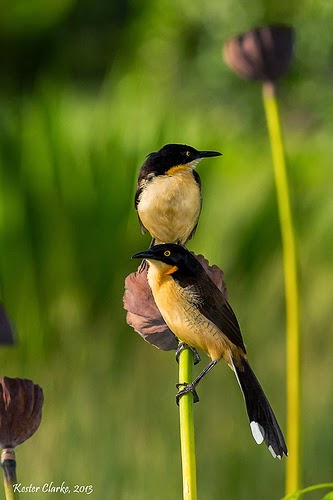
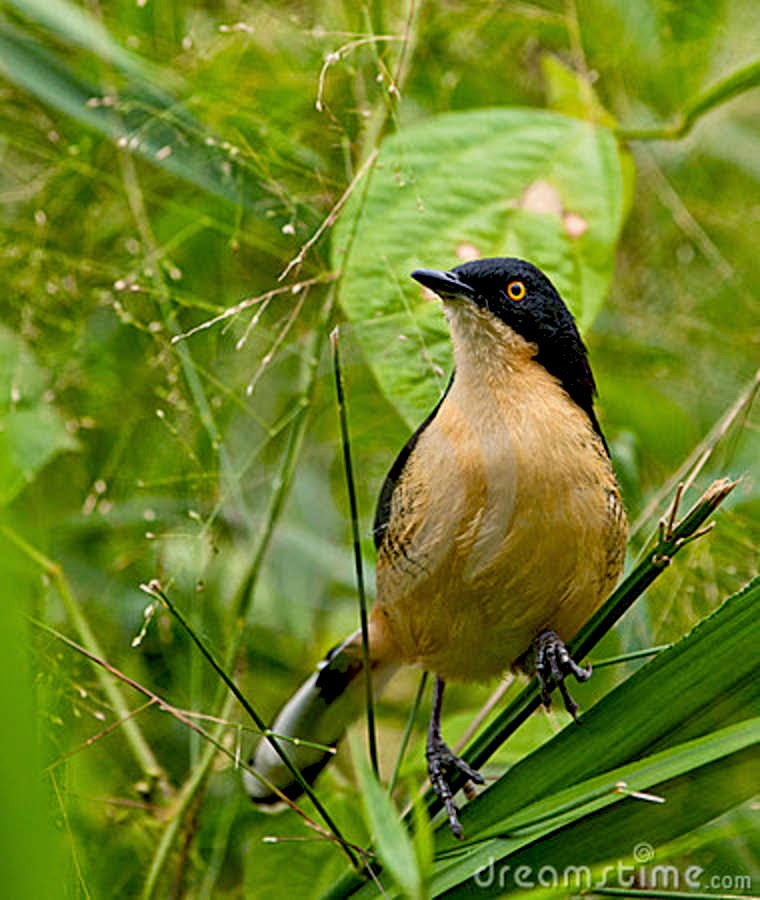
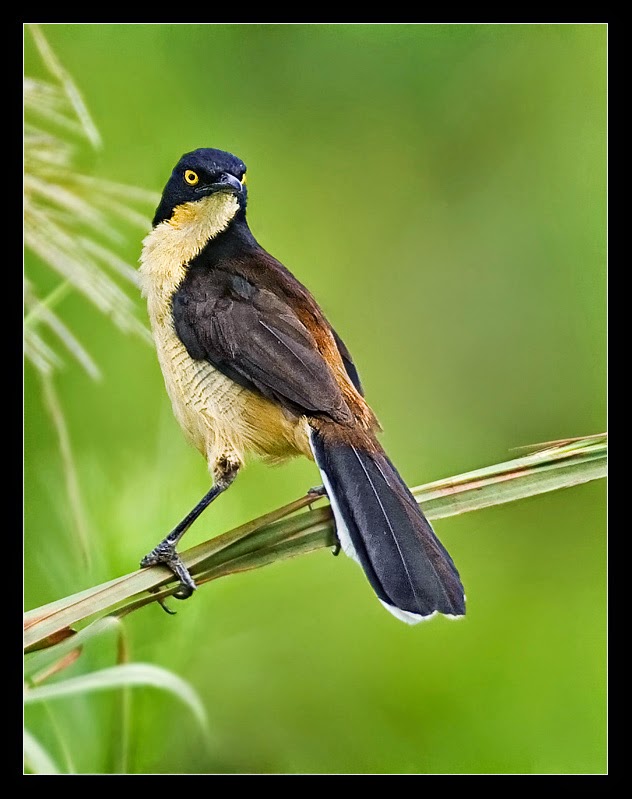
Black Capped Donacobius


Black Capped Donacobius - Mimik


Brazil, Pantanal, 2013

Description
The Black-capped Donacobius is a conspicuous, vocal South American bird. It is found in tropical swamps and wetlands in South America. It is unmistakable with a head and shoulders that are glossy black, a back that is more of a brown, and a rump that is olive-brown. Its tail feathers are black with noticeable white tips. Its wings are blackish with an obvious white flash at the bottom. The bird has underparts that are a warm yellow with black bars on its side. Its eyes are a bright yellow, and its legs are a dusky green. The black-capped donacobius also has a yellow cheek pouch that can puff out.


Habitat

Donacobius is resident along river edges with brushy areas and with invading dense vegetation in standing water. They need marshes for breeding. Black-capped Donacobiuses are common in a wide range of Amazonian wetlands.
Voice

Donacobius pair utters fascinating duets. Both perch close to each other, one above the other, and often facing each other. They call while bobbing their heads and wagging their fanned tails jerkily. The upper bird utters a hard “chrrr” and the other a loud “kweea”. At this time, we can often see the orange-yellow pouches exposed.
This melodious duet lasts some seconds, and it is used for to keep away potential intruders. Male gives series of liquid whistles and female utters a lower grating sound. Male’s call varies in intensity from slow repetitions of whistles to rapid bursts of notes when it is very excited.


Diet
Donacobius feeds mainly on invertebrates. It gleans from leaf surface in grass, and may also catch flying insects, from low perches over water. It forages in vegetation and grassy marshes where it probes and plugs insects. Donacobius is probably entirely resident in its range. Pairs live in narrow territories along water edges. A large portion consists of marshy edges.
Reproduction

Donacobius’s nest is built in vegetation, reeds or grass, often over standing water, at about 25 cm to one meter above water. But nest may be built in other places, and when it is not over water, nest is located higher, up to two meters above the ground. Nest is mainly built by female.
It is a bulky open cup (external sizes 10 to 15 cm) with a nesting cup of 6cm depth and 8 cm in diameter. Nest is made with grass, plant fibers, and other materials frequently added, such as snake skins and silk from spider webs and cocoons. Donacobius may also take some materials from nests of other species. Breeding occurs during rainy months.
Female lays 2 purplish-white eggs, heavily spotted with reddish and purplish. Incubation lasts about 16 to 18 days, by female alone. Altricial chicks are naked at hatching. Adults wet them with their own soaked feathers, after immersion into the water.
Young are fed by both parents, but also by helpers which are offspring from the last breeding season, or for one or two seasons before. Young fledge when they are 17 to 18 days old.
When nesting care is shared by pair and helpers, broods are more productive. Helpers assist breeding pair in defense of the territory, feeding young and guarding the nest.
This species seems to produce one single brood and a second clutch of replacement if the first is lost. But sometimes, pair may produce two broods per year. Mates stay together all their life.


Photos by others.


http://www.treknature.com/gallery/South_America/Peru/South/Madre_de_Dios/photo226561.htm

Credits

Avibase, Planetofbirds.com, Oiseoux-birds.com